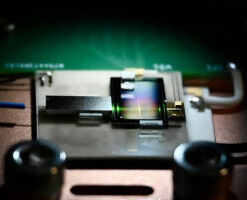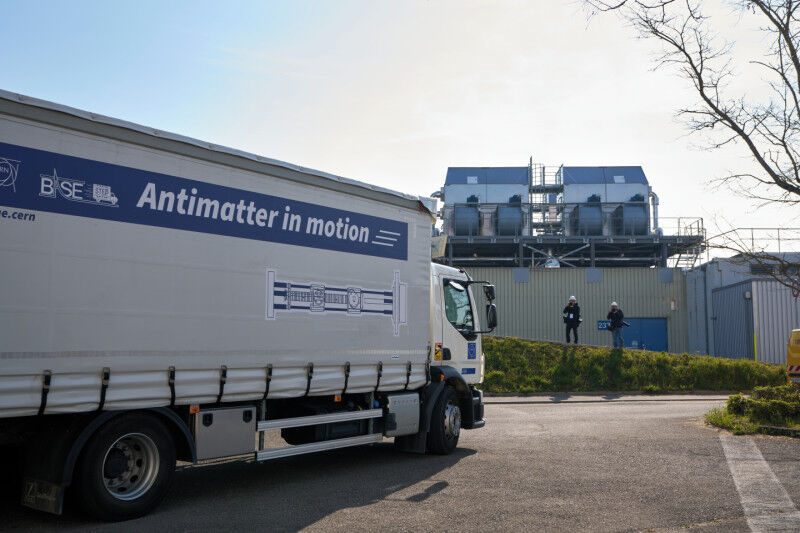
For the first time in the world, a team of physicists from the BASE experiment at CERN have succeeded in transporting a trap containing antiprotons across the laboratory’s main site on board a truck. The researchers succeeded in accumulating a cloud of 92 antiprotons in an innovative portable cryogenic Penning trap, then disconnecting it from the experimental installation, loading it onto a vehicle and resuming operations after transport. This is a remarkable feat, as antimatter is extremely difficult to preserve: the slightest contact with ordinary matter annihilates it.
This world first is a test phase. The ultimate goal is to be able to transport antiprotons to other European laboratories, such as the Heinrich Heine University in Düsseldorf, to carry out high-precision measurements on the fundamental properties of these particles.
A fundamental mystery of physics
Antimatter is a class of particles naturally present in the Universe, almost identical to ordinary matter, but with an inverted electric charge and magnetic moment. According to the laws of physics, the Big Bang should have produced equal quantities of matter and antimatter. These opposing particles should then have annihilated completely, leaving an empty Universe.
However, the Universe we observe today is composed almost exclusively of matter. This asymmetry is one of the greatest mysteries of modern physics. Researchers suspect the existence of very subtle differences between matter and antimatter, which could explain why matter has survived while antimatter has almost disappeared.
Measuring the properties of antiprotons with extreme precision
To better understand this enigma, the BASE collaboration is seeking to measure the properties of antiprotons with extreme precision, in particular their intrinsic magnetic moment, and then compare these results with those obtained for protons. But these measurements come up against an experimental difficulty.
"The machines and equipment in CERN’s "antimatter factory", where BASE is located, generate magnetic field fluctuations which limit the magnetic field of protons.the machines and equipment in CERN’s ’antimatter factory’, where BASE is located, generate magnetic field fluctuations that limit the precision we can achieve", explains Stefan Ulmer, spokesperson for the experiment. Yet these fluctuations are minute, in the order of a billionth of a tesla - around twenty thousand times weaker than the Earth’s magnetic field - and undetectable outside the building. "However, the precision of our measurements is such that to go any further, it will be necessary to move the experiment outside the building," he adds.
CERN’s "antimatter factory
CERN is the only place in the world where antiprotons can be produced, stored and studied. Two successive decelerators, the Antiproton Decelerator (AD) and the Extra Low Energy Antiproton Ring (ELENA), provide several experiments with low-energy antiprotons, which are easier to trap and analyze.
The BASE experiment has long held the record for antiproton storage, with durations exceeding one year. To reach a new milestone, physicists have developed a novel approach: transporting the antiprotons to a quieter experimental environment, in order to carry out even more precise measurements and share them with other laboratories. With this in mind, the BASE-STEP device was designed, a trap designed to store and transport antimatter.
A portable trap for transporting antimatter
"Our aim with BASE-STEP is to be able to capture antiprotons and deliver them to dedicated precision laboratories at CERN, Düsseldorf, Leibniz University Hannover and possibly elsewhere," explains Christian Smorra, head of the BASE-STEP project. "We validated the concept with protons last year, but today’s success with antiprotons represents a major breakthrough. "
The device is compact enough to be transported in a truck and pass through standard laboratory doors, while withstanding the vibrations of transport. The current device, which comprises a superconducting magnet, a liquid helium cryogenic system, energy reserves and a vacuum chamber, is designed for use with antiprotons.nergy reserves and a vacuum chamber where antiparticles are confined by electric and magnetic fields, weighs around a ton. Despite this, it remains much more compact than the conventional facilities used to study antimatter.
A technological challenge for transport
"To reach our first destination laboratory in Düsseldorf, it would take at least eight hours," explains Christian Smorra. "During this time, the superconducting magnet must remain below 8.2 kelvin. So, in addition to liquid helium, we’d need a generator to power an on-board cooling system. We are currently investigating this possibility. "
The most delicate challenge, however, remains arrival at destination: the antiprotons have to be transferred to the experiment without being annihilated.
A major step towards new experiments
"Antimatter transport is a pioneering and ambitious project. I congratulate the BASE collaboration on this impressive milestone", says Gautier Hamel de Monchenault, Director of Research and Informatics at CERN. "We are at the start of an exciting scientific journey that will further deepen our understanding of antimatter. "