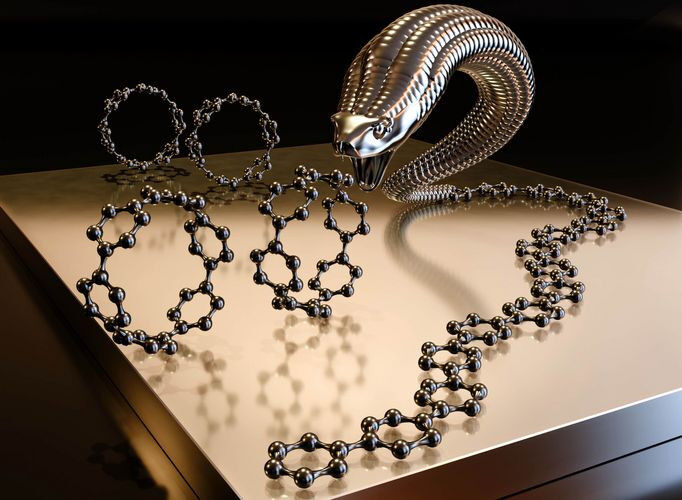
Researchers have produced exceptionally long chains of an electrically conductive polymer known as poly(p-phenylene) (PPP). The longest of these chains measure almost one micrometre in length - roughly one thousandth of a millimetre. This makes them nearly ten times longer than chains previously achieved. An interdisciplinary team of chemists and physicists from the Universities of Marburg, Gießen and Leipzig, together with researchers in China, has now demonstrated for the first time that this material can be synthesised in a new way. In this process, the molecular chains grow step by step from one end, much like a string of beads to which new beads are continuously added. The new synthesis method does not require halogens and produces no disruptive by-products. This makes it possible to obtain very pure and exceptionally long polymer chains, which could be of interest for future electronic materials. The findings have just been published in the journal Nature Chemistry.
Oneand two-dimensional carbon structures, such as conjugated polymer chains, exhibit semiconducting properties and are considered a next step in the development of new semiconductor technologies. Achieving this requires extended structures, making the development of long chains particularly important.
Targeted chain growth
In contrast to previous surface-based coupling reactions, in which many short molecular fragments come together randomly, here a chain grows in a controlled manner at each end: strained ring molecules are opened by the reactive chain end and attached to the chain. "This mechanism prevents by-products that would otherwise block the surface for further reactions," explains chemist Michael Gottfried from Marburg University. Using high-resolution scanning tunnelling microscopy (STM) and non-contact atomic force microscopy (nc-AFM) with a functionalised tip, the researchers were able to directly visualise individual bonds. X-ray photoelectron spectroscopy (XPS) and NEXAFS measurements additionally confirmed the chemical changes during the reaction.
Density functional theory calculations from Professor Ralf Tonner-Zech’s group at Leipzig University’s Faculty of Chemistry corroborated the proposed reaction pathway and explained the energetic advantages of chain growth. Ultralong PPP chains can be converted into novel nanoribbons, up to around 40 nanometres in length, by controlled heating via specific intermediate stages. "We later combine two chains to form a new carbon ribbon - much like a zip," explains Gottfried. "The theoretical calculations help us to better understand the experimental formation mechanism," adds Tonner-Zech.
Potential applications for molecular semiconductor devices
The work is basic research in the best sense of the word: it expands the chemical toolkit for producing atomically precise carbon structures - potential building blocks for future molecular electronics, organic transistors or novel semiconductor nanoribbons. "PPP is one of the conjugated polymers whose electronic properties depend heavily on chain length and structural perfection," comments Gottfried. At the same time, the ultra-long chains now available serve as a starting point for defined carbon nanoribbons with tailor-made properties.
Long-standing collaboration and emerging fields of research
The breakthrough was made possible by the close interaction of chemical design, surface physics, high-resolution microscopy and theory between the Universities of Marburg, Gießen and Leipzig together with partners in China (Hefei and Suzhou). The collaboration between the universities in central Hesse and Leipzig University has developed into a close and successful partnership over many years, strengthened in particular through the Collaborative Research Centre, Structure and Dynamics of Internal Interfaces. A large number of joint publications have emerged from this collaboration, particularly from the partnership between Gottfried’s experimental group at Marburg University and Tonner-Zech’s theory group at Leipzig University.
The publication is also of particular significance for Leipzig University, as it forms one of the foundations for ReMIL ( Responsive Molecules and Ions in Layers , an emerging field of research recently approved by the Rectorate. The new research field, led jointly by Tonner-Zech and Professor Jonas Warneke (both at the Wilhelm Ostwald Institute of Physical and Theoretical Chemistry, Faculty of Chemistry), focuses on the targeted design of functional ultrathin layers at interfaces.
Original title of the publication in Nature Chemistry:
" On-Surface Radical Ring-Opening Polymerization Produces Ultra-Long Poly(p-phenylene) for Access to Nonbenzenoid Carbon Nanoribbons" , DOI: 10.1038/s41557-026-02092-y