

news 2026
« BACK
 Novel 2D materials gain momentum
 A 3D printable scaffold to support fast bone growth
 In Search of the Room Temperature Superconductor: International Team Formulates Research Agenda
 Large area MoS2 reduces energy loss in magnetic memory films
 A flexible electrolyte for solid batteries
 Using Tiny Ripples at Skin Level to Monitor for Possible Health Problems Below
 Wageningen researchers break through material theory with new type of plastic
 Better protection for perovskite solar cells against environmental influences
 Did you hear about the lab-made ear?
 When records are not enough
 Nanodevice produces continuous electricity from evaporation
 Next-Generation Solar Cells
 When heat flows like water
 Elephant trunk whiskers exhibit material intelligence
 How superconductivity arises: New insights from moiré materials
 Optical temperature sensing from cold to very hot
Materials Science
Results 1 - 20 of 25.
Materials Science - Physics - 12.03.2026
There is more than just graphene: In an interdisciplinary project, researchers have focused on a new class of two-dimensional materials known as MXenes. This versatile group of materials is suitable for a wide range of applications, from energy storage to medicine. Two-dimensional materials consisting of a single layer of atoms are currently the subject of intense research.
Materials Science - Life Sciences - 11.03.2026
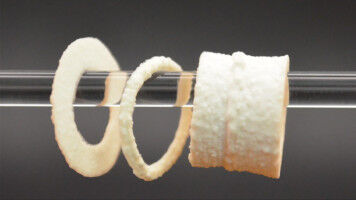
A bone-like composite developed at EPFL uses naturally occurring enzymes to accelerate mineralization through an energy-efficient, room-temperature process. The strong, lightweight material shows promise for bone repair applications. Inspired by the resilient and self-repairing mechanical properties of bone, scientists have been developing synthetic materials using one of bone's main components: a mineral called hydroxyapatite (HA).
Physics - Materials Science - 09.03.2026
In a current strategy paper, an international team with the participation of TU Graz calls for the search for room-temperature superconductors to be pursued in a coordinated manner and with combined forces - and presents a programmatic approach for its success. The search for materials that can conduct electricity at room temperature without losing energy is one of the greatest and most consequential challenges of modern physics: loss-free power transmission, more efficient motors and generators, more powerful quantum computers, cheaper MRI devices.
Physics - Materials Science - 06.03.2026
Scientists at the University of Manchester have discovered that placing magnetic films on atomically thin molybdenum disulfide (MoS2) fundamentally changes how they lose energy, a finding that could bring 2D-material spintronics a step closer to real devices. The team found that growing a widely used magnetic alloy, permalloy, on ultra-thin MoS2 alters the film's internal crystal structure, changing how and where energy is lost as magnetic spins move.
Materials Science - Chemistry - 05.03.2026
New research could help lithium-ion batteries reach their full potential
New research into why lithium-ion batteries tend to lose power over cycles of charge and discharge could help unlock the next generation of more durable, fast-charging power cells. An international team of chemists and engineers from the UK, China, and Germany have published a paper which challenges the conventional assumptions about how batteries should be optimised to maximise performance, highlighting the importance of electrical, rather than ionic, conductivity.
Microtechnics - Materials Science - 05.03.2026
Graphene-based ’artificial skin’ brings human-like touch closer to robots
Robots are becoming increasingly capable in vision and movement, yet touch remains one of their major weaknesses. Now, researchers have developed a miniature tactile sensor that could give robots something much closer to a human sense of touch. The technology, developed by researchers at the University of Cambridge, is based on liquid metal composites and graphene - a two-dimensional form of carbon.
Materials Science - Chemistry - 05.03.2026
Solid-state batteries do not use flammable liquid electrolytes and are therefore safer than conventional lithium-ion batteries.
Health - Materials Science - 04.03.2026
Caltech scientists have developed a method that detects tiny, imperceptible movements at the surface of objects to reveal details about what lies beneath. By analyzing the physics of waves traveling across the surface of an object-whether that be a manufactured product or the human body-the new technique can determine both the stiffness and thickness of the underlying material or tissue.
Materials Science - 26.02.2026
Researchers at Wageningen University & Research have developed a new type of plastic that could not exist according to materials theory. Its properties lie between glass and plastic: it is easy to shape and resists impact. This combination arises because the building blocks are not chemically attached to each other, but are held together by physical forces.
Materials Science - Chemistry - 25.02.2026
Wageningen researchers break materials theory with a new type of plastic
Researchers at Wageningen University & Research have developed a new type of plastic that, according to materials theory, should not be able to exist. Its properties sit somewhere between those of glass and plastic: it is easy to (re)shape, yet resistant to impact. This unusual combination is possible because the building blocks of the material are not held together by chemical bonds, but by physical forces.
Chemistry - Materials Science - 25.02.2026
A team from the University of Stuttgart and international researchers have succeeded in making perovskite solar cells more efficient and more resistant to environmental influences. This is another important step towards the application of a technology that holds great promise for photovoltaics. Optimal material mixture sought Perovskite solar cells are a promising technology for photovoltaics.
Innovation - Materials Science - 24.02.2026
Lithium and sodium-ion technologies are more closely linked than assumed
Study shows: "Switching to a new battery technology does not automatically open the door to new market players" Batteries are considered a key technology for the global energy and mobility transition. In addition to established lithium-ion batteries, sodium-ion batteries are becoming increasingly important, primarily due to their cost advantages and independence from scarce raw materials such as lithium or cobalt.
Life Sciences - Materials Science - 24.02.2026
An artificial ear that feels just like the real thing: in laboratory experiments, researchers have produced ear cartilage that remains form-stable in animal models. Only one element is missing to make the tissue as elastic as a natural ear. For over 30 years, researchers have sought to produce an ear in a laboratory from a patient's living cellular material.
Materials Science - Environment - 24.02.2026
It is not easy to bring new technologies from the laboratory to market. Researchers and companies face very different demands for new developments and do not always find common ground. Scientists at Empa and other institutions have analyzed two emerging solar cell technologies to identify the greatest risks.
Materials Science - 19.02.2026
A nanodevice developed at EPFL produces an autonomous, stable current from evaporating saltwater by using heat and light to control the movement of ions and electrons. In 2024, researchers in the Laboratory of Nanoscience for Energy Technology ( LNET ) in EPFL's School of Engineering reported a platform for studying the hydrovoltaic (HV) effect - a phenomenon that allows electricity to be harvested when fluid is passed over the charged surface of a nanodevice.
Chemistry - Materials Science - 16.02.2026
ISTA physicists explain the exceptional energy-harvesting efficiency of perovskites Despite being riddled with impurities and defects, solution-processed lead-halide perovskites are surprisingly efficient at converting solar energy into electricity. Their efficiency is approaching that of silicon-based solar cells, the industry standard.
Physics - Materials Science - 13.02.2026
Researchers have shown theoretically that, in highly ordered materials, heat can flow toward warmer regions without violating the laws of thermodynamics. Their work could help design electronics that minimize heat loss. To understand how heat normally flows, you could study the second law of thermodynamics - or wrap your hands around a hot mug of coffee.
Life Sciences - Materials Science - 12.02.2026
Sense of touch despite thick elephant skin: Researchers have discovered that the hairs on elephants' trunks are responsible for their extraordinary sense of touch. Special material properties: Elephant sensory hairs have a stiff base and a soft tip, which enables them to precisely feel objects and recognize where contact is made.
Physics - Materials Science - 05.02.2026
Researchers involving the University of Würzburg discover microscopic connection between correlated electron states and superconductivity. The study is published in Nature. How exactly unconventional superconductivity arises is one of the central questions of modern solid-state physics. A new study published in the scientific journal Nature provides crucial insights into this question.
Materials Science - 04.02.2026
An international collaboration involving researchers from the University of Innsbruck has developed a novel luminescent material that enables particularly robust and precise optical temperature sensing across an exceptionally broad temperature range. Optical luminescence thermometry has been gaining increasing importance, as it allows contactless temperature measurement even under extreme conditions.


