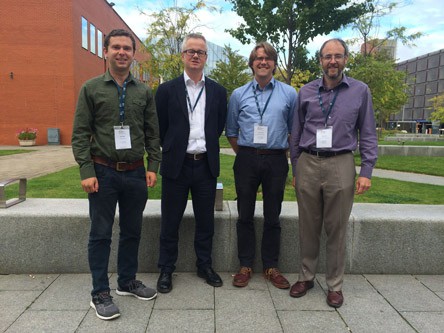
Left to right: Ben Powell (University of Bristol), Guy Nason (University of Bristol), Duncan Elliott (Office for National Statistics) and Paul Smith (University of Southampton)
A team of statisticians from the Universities of Bristol and Southampton and the Office for National Statistics have been chosen to present a prestigious Read (Discussion) Paper at a plenary session of the Royal Statistical Society's international conference in Manchester today (Tuesday, September 6). The paper presents new research in the field of time series analysis and decision theory that helps decide whether it is worth sampling a time series more frequently. Professor Guy Nason , from the Institute of Statistics in the School of Mathematics at the University of Bristol, said: "Statistics collected through time are known as time series - for example economic figures, such as Gross Domestic Product (GDP) or the rate of inflation that are released every quarter. "Increasing the frequency of collection, such as moving to monthly statistics, always increases the amount of information available. However, the cost of more frequent collection can outweigh the value of the information obtained. "Our research enables a rational analysis that sheds light on whether it is worth sampling more frequently.
TO READ THIS ARTICLE, CREATE YOUR ACCOUNT
And extend your reading, free of charge and with no commitment.