The scientists describe their method in a paper that appears in the journal Nature Communications. The work was completed in the lab of Julia R. Greer , the Ruben F. and Donna Mettler Professor of Materials Science, Mechanics and Medical Engineering at Caltech, and Huajian Gao of Tsinghua University in Beijing.
The researchers use a technique called two-photon lithography that allows them to sequentially build an object of a desired size and shape by carefully controlling the geometry at the level of individual voxels, the smallest distinguishable volumes, or features, in a 3D image. Beginning with a light-sensitive liquid, the scientists use a tightly focused femtosecond laser beam-a femtosecond is 1 quadrillionth of a second-to build a desired shape out of a gel-like material called hydrogel. After infusing the miniature hydrogel sculpture with metallic salts, such as copper nitrate or nickel nitrate, they heat the structure twice in a specialized furnace to produce a shrunken metallic replica of the original shape.
"That’s where the magic happens," says Greer, who is also the executive officer for applied physics and materials science at Caltech. First, the scientists burn off all the organic compounds present in the hydrogel, leaving a metal oxide such as nickel oxide or iron oxide. Sometimes, as when they are creating lenses or other optical elements, the desired product is complete after this first thermal step. For other materials, the researchers conduct a second thermal step using a different set of gases in the furnace to remove oxygen by reducing the metal oxide, leaving only the desired metal structure.
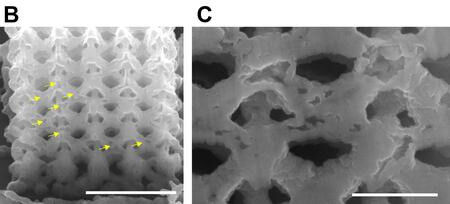
"Because of this thermal process, there’s a tremendous amount of shrinkage," Greer says. In fact, the process can reduce the preheated volume by as much as 90 percent, yielding tiny lattices or heat exchangers, for example, with overall dimensions smaller than 50 microns and building blocks measured in nanometers.
Building Reliable Models
Greer’s team can also dissect these miniature structures, revealing every defect present. In fact, the team discovered that these nanostructures are far from perfect-they contain numerous flaws, such as pores, grain boundaries, and even inclusions or impurities. If these kinds of microstructures were found in macro-sized metallic parts, the materials would likely be disqualified because they would be weak and susceptible to failure.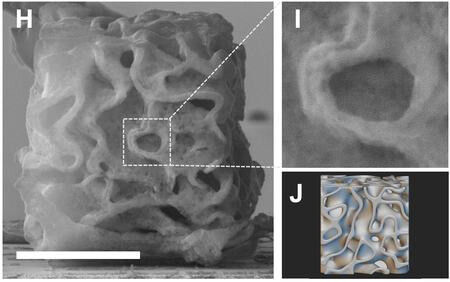
Greer underscores that unlike other models of structural parts that either treat materials as ideal or do not accurately account for defects, the models her collaborators at Nanyang Technological University in Singapore have developed are physically relevant and reliable.
"We put exactly the microstructure we uncovered into the models. It’s not an inference. It’s not representative. It’s the actual microstructure that we made," Greer explains. As a result, for the first time, the models predict the correct, observed strengths of the fabricated parts.
"I think this work basically shows that in the future, even when we ’nano-architect’ our world with custom parts, we’ll be able to reliably predict their properties, something society hasn’t been able to accomplish yet," Greer says. "And we don’t have to disqualify a part simply because it contains defects."
The lead authors of the paper, "Nanoporosity-Driven Deformation of Additively Manufactured Nano-Architected Metals," are Wenxin Zhang (PhD ’25) and Zhi Li, who is now at Nanyang Technological University in Singapore.