From GPS satellites to mobile networks, modern technology relies on ultra-precise radio signals. Engineers have long tried to generate them on chips using interactions between light and sound, but the effect was too weak. University of Twente researchers now show in Nature Photonics that a thin glass layer creates ’mini-earthquake’ surface acoustic waves, that make the effect more than 200 times stronger. This enables ultra-pure signals and record-sharp filters on a device thousands of times smaller.
Every time you make a phone call, your signal is filtered out of a crowded radio spectrum using radio frequency filters. These components let through only the frequencies you want and block everything else. The sharper the filter, the cleaner the call. The same principle applies in radar, satellite navigation and future wireless networks like 6G.
For decades, researchers have dreamed of building these filters using light. Then they can combine the precision of lasers with the flexibility to work anywhere in the radio spectrum, all’on a chip the size of a fingernail. Silicon nitride, already widely manufactured for optical applications, seemed like the perfect foundation. But there was a catch: to generate the sharpest signals, light and sound need to interact strongly inside the chip material. In silicon nitride, that interaction has always been weak. Previous attempts to fix it required exotic, unstable materials or fragile structures too delicate to survive outside a laboratory.
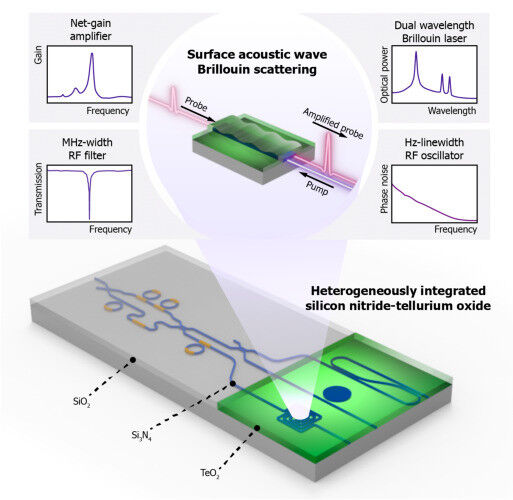
In a collaboration with McMaster University in Canada, the Twente team found the answer in tellurium oxide, a material already used in commercial modulators, applied as a thin coating on a standard silicon nitride chip. The coating generates a special type of sound wave resembling a tiny earthquake that travels along its surface and locks onto the laser light inside far more tightly than anything achieved before in silicon nitride, making the interaction more than 200 times stronger.
That strength unlocks three things previously out of reach on a standard silicon nitride chip. The first is a Brillouin sound amplifier that actually works: earlier silicon nitride chips would weaken a signal as it travelled through, like shouting down a corridor that swallows your voice. This chip amplifies it instead. It’s a first for the platform, and a critical missing piece for practical applications.
The second is a radio signal of extraordinary purity. Using a resonator barely half a millimetre across, the chip generates a radio tone so stable, flexible and precise it rivals instruments that used to require hardware the size of a steering wheel. "We did it on a chip you could fit on your fingernail," says corresponding author David Marpaung.
The third is a filter so sharp it can isolate a single radio channel from a spectrum packed with thousands and slide that window anywhere across a nine-gigahertz stretch of the radio dial. To the researchers’ knowledge, no integrated chip filter has ever achieved this resolution. It is exactly what future base stations and radar systems need.
The result did not come quickly. The paper took more than a year and a half to move from submission to acceptance in Nature Photonics, with reviewers repeatedly demanding more evidence. "Every time they asked for more proof, we went back and found something even better," says first author Yvan Klaver. "In the end, the paper is stronger for it."
The researchers are clear that this is an opening move. Because the tellurium oxide coating can be switched on only where it is needed, it sits comfortably alongside other technologies already available in silicon nitride: amplifiers, lasers and sensors, without interfering with them. "This platform connects an entire ecosystem of photonic technologies," says Marpaung. "The applications we haven’t thought of yet are probably the most exciting ones."
The study, titled Surface acoustic wave Brillouin photonics on a silicon nitride chip , is published in Nature Photonics. The research is the result of a long-running collaboration between the University of Twente and McMaster University in Canada. The partnership was initiated by Roel Botter, who completed his PhD at the University of Twente in 2024 and now works at LioniX, together with McMaster PhD candidate Bruno Segat Frare. Batoul (Tahoora) Hashemi, also a McMaster PhD candidate, took The McMaster team worked under the supervision of Prof. Jonathan Bradley.
At the University of Twente, the research was led by Prof. David Marpaung , with first author Yvan Klaver and Riley te Morsche as key contributors. All are from the research group Nonlinear Nanophotonics (NLNP ; Faculty of S&T / MESA+ institute )
DOI: s41566-026-01873-8