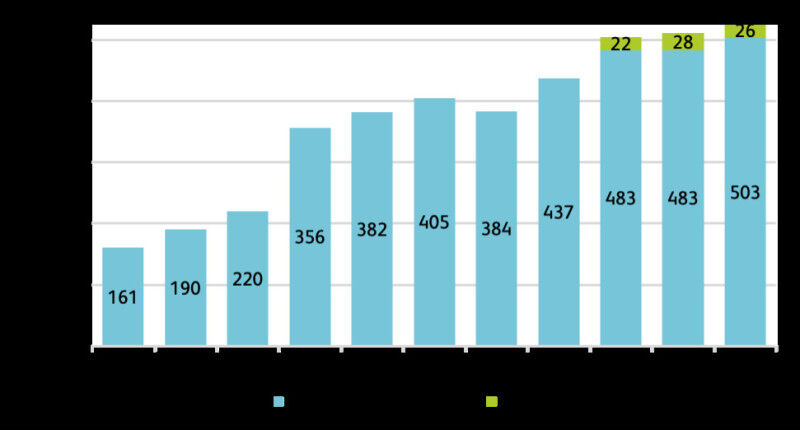
The number of FinTech companies in Switzerland and Liechtenstein increased slightly in 2025. At the same time, the technological focus is shifting towards data- and AI-based solutions. This is the conclusion of the new IFZ FinTech Study 2026 by Lucerne University of Applied Sciences and Arts.
At the end of 2025, a total of 529 FinTech companies were counted in Switzerland and Liechtenstein (see Figure 1). This represents growth of four percent compared to the previous year. With the exception of a slight decline in 2021, the number of FinTech companies has risen almost continuously since 2015 and more than tripled in the period under review. At the same time, annual growth in recent years has been lower than in previous growth phases. The development is characterized by simultaneous market entries and market exits: company start-ups, liquidations, mergers and strategic realignments are largely in balance.
This development points to a new phase in the FinTech ecosystem. After previous years of comparatively strong growth, consolidation, specialization and technological repositioning of business models are coming to the fore. FinTech activity remains regionally concentrated, with Zurich maintaining its position as the largest location, followed by the canton of Zug.
Technological focus shifts towards AI
The technological structure of the FinTech sector is also changing. Data analysis, big data and artificial intelligence now represent the largest technology class (see Figure 2, right-hand chart). "The growing importance of artificial intelligence is not only due to new start-ups," says co-author Thomas Ankenbrand. "Existing FinTech companies have also developed their technological focus towards data and AI-based applications," adds Ankenbrand. This development reflects the growing use of data-driven applications, automated decision-making processes and generative AI in financial services. At the same time, distributed ledger technology remains important, particularly in the area of financial infrastructure.
At business division level, infrastructure became the largest product segment for the first time, ahead of investment management (see Figure 2, left chart). This underlines the trend of FinTech companies providing technological foundations for established financial institutions.
Technological focus shifts towards AI
The technological structure of the FinTech sector is also changing. Data analysis, big data and artificial intelligence now represent the largest technology class (see Figure 2, right-hand chart). "The growing importance of artificial intelligence is not only due to new start-ups," says co-author Thomas Ankenbrand. "Existing FinTech companies have also developed their technological focus towards data and AI-based applications," adds Ankenbrand. This development reflects the growing use of data-driven applications, automated decision-making processes and generative AI in financial services. At the same time, distributed ledger technology remains important, particularly in the area of financial infrastructure.
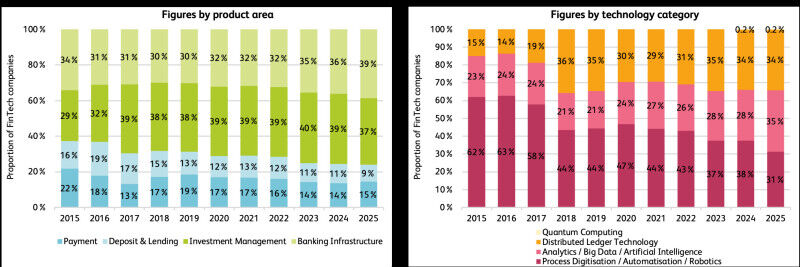
At business division level, infrastructure became the largest product segment for the first time, ahead of investment management (see Figure 2, left chart). This underlines the trend of FinTech companies providing technological foundations for established financial institutions.
International B2B strategies as a feature of the FinTech market
The FinTech sector in Switzerland and Liechtenstein remains focused on business-to-business (B2B) business models and global markets. The majority of companies primarily target institutional clients and also operate across borders, which underlines the global and infrastructure-oriented nature of the FinTech ecosystem. Business models focused on end customers make up a smaller part of the ecosystem and are also more strongly geared towards the domestic market. Parallel to this development, monetization has also shifted towards technology-driven revenue models in recent years: Software-as-a-Service (SaaS) in particular has established itself as the most common approach over time, reflecting the growing importance of scalable software solutions as a key source of value creation in the FinTech sector.
Good framework conditions in international comparison, but declining venture capital momentum
Switzerland as a FinTech location is maintaining its strong international position in the global competition between financial technology centers. In the IFZ FinTech Hub Ranking, Switzerland, represented by Geneva and Zurich, remains one of the world’s leading locations and, with these two hubs, is positioned directly behind the leading FinTech center Singapore. However, venture capital activity is declining compared to previous peak years. Although this trend is also evident at a global level, it is noticeable for the financial centers of Switzerland and Liechtenstein. The underlying causes cannot yet be clearly explained and open up a field for future research and in-depth analysis.
Evolution rather than disruption characterizes the technological transformation
The technological transformation of the financial centers of Switzerland and Liechtenstein appears to be more evolutionary than disruptive. Past developments indicate that new technologies in financial institutions are primarily being integrated gradually rather than fundamentally changing existing structures. Meanwhile, the efficiency ratios of Swiss banks have improved in recent years: business volumes, measured in terms of total assets and assets under management, have grown faster than costs. The extent to which these efficiency gains can be attributed to FinTech innovations cannot be clearly determined. However, the trends suggest that financial institutions are focusing on continuous innovation and implementing technological advances in close collaboration with IT and technology providers.
What is FinTech?
The Lucerne University of Applied Sciences and Arts publishes the "IFZ FinTech Study" every year. FinTech is the abbreviation for financial technology and describes technology-based solutions for innovative digital products, services and processes in the financial sector. FinTech solutions improve, supplement or replace existing financial services.
IFZ FinTech Study 2026
The study provides an overview of the Swiss FinTech sector for the eleventh time. The study was made possible thanks to the support of Finnova, Finstar, Inventx, the Canton of Zug, SFTI / Swiss FinTech Innovations, SIX and Zürcher Kantonalbank.