


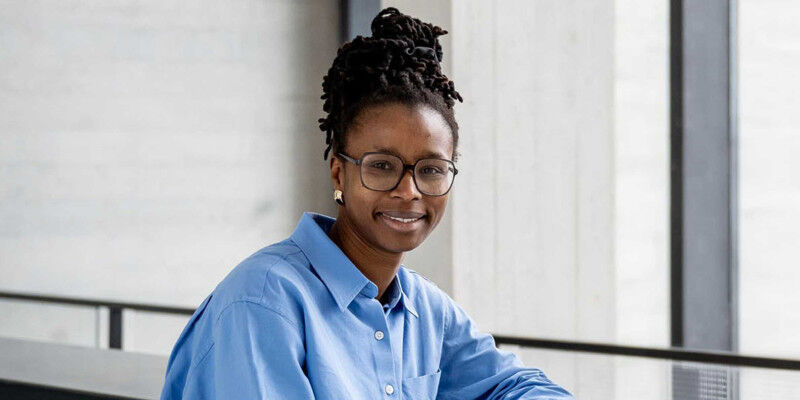
At ETH Zurich, Grace Kagho is building a digital twin of her hometown Lagos. As a researcher and an entrepreneur, she is working to make her data-driven approach to sustainable urban planning available to cities worldwide.
"The thing I struggled with most in Lagos was the gridlocked traffic. I never knew when a bus would turn up," says 33-year-old Grace Kagho, reflecting on her days in the Nigerian megacity. Born in the south of the country and raised in Lagos, Kagho spent her early years reading historical novels, penning poems and writing short stories. Inspired by a book about a woman who test-flew fighter jets, her dream was to become a pilot and an aeronautic engineer. "But my dad encouraged me to explore other options," she says with a smile.
Her keen interest in how computers work led her to Covenant University in Ota, where she completed a Bachelor’s degree in Computer Engineering. Back then, she was already an avid fan of anime films, which sparked an interest in Japanese culture, technology and society. Fascinated by this faraway country, she snapped up the opportunity to pursue a Master’s degree in global engineering at the Tokyo Institute of Technology.
There, Kagho developed her interest in resilient cities - urban spaces that can withstand crises without losing their ability to function. As a natural problem-solver who had always wanted to make the world a better place, she was intrigued by the question of what makes a city work - and more specifically, how Lagos could ensure its buses arrived on time. Her idea was simple: might digitalisation and visualisation be the answer to optimising the transport network?
An exchange programme at ETH Zurich brought her a step closer to that vision. For the first time, she was able to simulate traffic in Lagos on a computer using agent-based modelling. In 2019, she completed her Master’s degree in Tokyo and returned to ETH as a doctoral candidate. It was then that she began to flesh out her idea of an urban digital twin.
At the same time, Kagho was increasingly preoccupied by thoughts of how she could put her research into practice. That was when a fellow student told her about the ETH Social Impact Pioneer Fellowship - a funding programme designed to foster the creation of companies that benefit people in lowand middle-income countries. The prospect of turning her research findings into a company and making a lasting difference thrilled her. As a Pioneer Fellow, she drew on the extensive development know-how of her ETH coach Fritz Brugger, learned to think like an entrepreneur, and used her interaction and exchange with other Fellows to help shape her entrepreneurial journey.
The moment of truth came in February 2025, when Kagho founded UrbanEcho, an ETH spin-off that develops digital twins of cities. By combining population, demographic and behavioural data, the company creates a synthetic population that can be used to simulate and test various mobility scenarios. These simulations help local decision-makers devise sustainable strategies and improve urban transport systems. Alongside her burgeoning career as an entrepreneur, Kagho is also determined to continue her research. In tandem with her work at UrbanEcho, she is currently a researcher at the Sustainable Urban Transitions Lab led by ETH professor Bryan Adey. "My goal is to make data-driven solutions accessible worldwide so that we can tackle the challenges facing urban environments," she says.
