


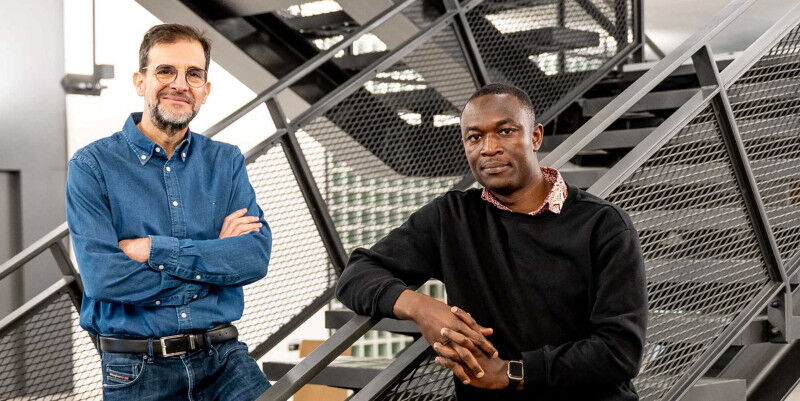
Timothy Asare from Ghana is a graduate of a joint Master’s programme run by Ashesi University and ETH Zurich. Today, he is working with ETH professor John Lygeros to develop sustainable power solutions for Ghana.
Mention Walenstadt and John Lygeros’ eyes light up. This municipality of 6,000 people in the canton of St. Gallen is where NCCR Automation is building a microgrid - a local electricity network powered by renewable energy and batteries, with community participation. The National Centre of Competence in Research on Dependable, Ubiquitous Automation, which Lygeros co-leads in tandem with his duties as head of the Automatic Control Laboratory at ETH, is developing the microgrid with a view to deploying advanced energy management and automation concepts. As he explains, this microgrid "offers the perfect opportunity to gather data while testing these concepts under real-world conditions". Or at least conditions in certain parts of the real world - after all, Walenstadt is in Switzerland, a wealthy country with a highly reliable nationwide grid.
This raises a question that has long intrigued Lygeros: could microgrids offer a solution for locations like sub-Saharan Africa that lack power infrastructure? With the UN predicting that many African countries will skip developing nationwide grids and move directly to local, standalone systems, Lygeros pitched a Master’s project to Ashesi University in Ghana. Before long, he was contacted by a smart, highly motivated student. For Timothy Asare, the topic - decentralised power distribution from sustainable sources - was a perfect match.
That was two years ago. Asare, now 32, has recently embarked upon a doctorate as a member of Lygeros’ research group in Zurich. Over the next four years, he plans to model the use of microgrids in Ghana, including the incorporation of electric vehicles. "EV batteries can be used to store surplus power," he explains, "which helps make the grid more stable and efficient. I’m currently developing and testing the necessary control systems and algorithms." In parallel, he will examine the economic viability of such systems in Ghana and investigate what regulatory frameworks might be required.
As one of six children raised in a farming family near the city of Sunyani in Ghana’s middle belt, Asare’s route to an engineering degree was anything but clear-cut. "In the early 2000s, most rural communities in Ghana weren’t connected to the national grid," he recalls. "Whenever we wanted to watch the news, my father would fetch the battery from the car and hook it up to our TV." A gas lamp provided light in the evenings. At the age of nine, following the death of his father, he went to live with his uncle in the Greater Accra Region, the area around the country’s capital. "Accra was already electrified, and I saw what a difference this made to people’s lives," he recounts. His uncle’s children were older than him and keen on maths and science. They would become his role models as his interest in science and technology began to blossom.
By the time he returned to Sunyani to attend high school, Ghana’s cities and most of its larger villages had been connected to the national grid. Yet rapid population growth and industrial expansion would regularly bring the system to its knees. It was the dawn of an era known in Akan, the local language, as "dumsor" ("off and on") - when often there was only power for a few hours a day. It was the kiss of death for many small and medium-sized food businesses, including cold storage operators and farmers, who were unable to properly refrigerate their wares. "That was a big reason why I opted to study electrical engineering," Asare says.
While at university, Asare spent his spare time devising low-tech ways of bringing power to those rural communities not yet connected to the national grid. His solution was to use the dynamos customarily fitted to bicycles, a common mode of transport in rural areas. "We attached a recycled battery to the bicycle frame and adapted the dynamo to recharge it during the day," Asare explains. At night, people were then able to use the battery to power an LED lamp or charge a mobile phone. With the help of friends and a grant of 5,000 US dollars, he equipped 70 households in two villages with these mobile bicycle-powered generation and storage devices: "I saw back then that even the modest technical knowledge we had acquired as students was enough to improve the lives of our fellow human beings."
About
Timothy Asare is an alumnus of Ashesi University and a doctoral candidate in the research group led by Professor John Lygeros.
John Lygeros is Professor for Computation and Control in the Department of Information Technology and Electrical Engineering at ETH Zurich.
First microgrid on campus
After graduating and getting his first taste of industry, Asare applied in 2021 to join the newly created Ashesi-ETH Master in Mechatronic Engineering. Established to educate the next generation of African engineers, this programme is run by academic staff from Ghana and Switzerland, with key input from Swiss industry partners. Asare received a scholarship from the chocolate manufacturer Barry Callebaut, a company based in Zurich that sources most of its cocoa from Ghana.
It was while looking for a topic for his thesis in 2023 that Asare came across Lygeros’ Master’s project. At the time, Ashesi University was drawing up plans for a new building, along with an additional power supply. This would create the perfect living lab to put a microgrid through its paces in Ghana - far removed from the safety net of the Swiss national grid. "We wanted to find out how big the microgrid would need to be," Asare explains, "and whether the investment would pay off." Compared to Europe, interest rates on loans are significantly higher in Ghana, which increases the lifetime cost of the installation.
After a succession of online meetings, Lygeros finally made the trip to Ghana in 2024 to meet up with Asare in person and get a feel for the situation on the ground. "In the evenings, we’d pop to the next village for a drink and often end up sitting in the dark because the power had gone off," says Lygeros. Back on Ashesi campus, diesel generators would spring to life and fill the gap. "But that’s very expensive in the long term," explains Lygeros. "So microgrids also offer an attractive option for Africa from an economic perspective."
Asare teamed up with a fellow student named Goodnews Iduku to analyse what equipment and capital expenditure it would take to boost the share of photovoltaic power on campus from 13 to 60 percent of total power supply. "It was amazing just how committed the two of them were," Lygeros recalls. "We’d discuss quite complex problems, and often they came back to me with suggestions just a few days later. I wondered sometimes if the two of them ever slept!"
Their dedication paid off: when it came to designing the power supply for the new facility, the university administration drew on the work carried out by the two students. What’s more, Asare was asked to stay on as a research assistant for another ten months after finishing his studies. Alongside photovoltaic panels and batteries, the new system also features various sensors and smart meters to monitor the microgrid’s performance. "This data will generate important know-how for the creation of further microgrids in Africa," Lygeros explains.
Asare’s doctoral project in Zurich has further intensified collaboration with his professor. "I’m sure the knowledge he gains here will be put to good use back in Ghana," Lygeros notes. "And that’s his primary concern: whether what he learns at ETH can be applied to what’s happening in Ghana." Asked about his future plans, Asare responds that he will go wherever his work has the biggest impact: "If I were to develop a new technology in Europe, it would probably only marginally improve people’s lives. But in Africa, there are lots of problems that my knowledge can help solve."
The joint ETH-Ashesi Master ’s programme enjoys the support of the following donors: Adrian Weiss, the Arthur Waser Foundation, Bärbel und Paul Geissbühler Stiftung, Georg und Bertha Schwyzer-Winiker Stiftung, the Green Leaves Education Foundation, the Louis Dreyfus Foundation and the Swiss State Secretariat for Economic Affairs.