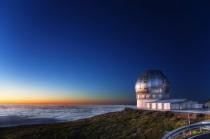
The scientists used used one of the world's most powerful telescopes, the Gran Telescopio Canarias in the Canary Islands off the northwest coast of Africa. This observatory includes a mirror almost 35 feet wide and is situated at one of the world's best locations for star-gazing.
Astronomers on two research teams, including an astronomer at Penn State, have demonstrated the power of a new technique to determine the chemical composition of planets far outside our solar system. Using the technique - called narrow-band transit spectrophotometry - the teams discovered the element potassium in the atmospheres of giant planets similar in size to Jupiter. "This discovery illustrates the power of new instrumentation on the world's largest optical telescopes, to not just discover planets, but also to study exoplanetary atmospheres in detail. Such techniques could one day aid in the confirmation of the atmospheric constituents of planets more like our own," said Suvrath Mahadevan, assistant professor of astronomy and astrophysics at Penn State and a researcher in the Penn State Center for Exoplanets and Habitable Worlds. The planets are much hotter than Jupiter, up to 1,000 degrees Centigrade (1,832 degrees Fahrenheit) or more, and they are very far away from Earth - one named HD 80606 b located at about 190 light years and the other named XO-2b located almost 500 light years away. The findings of both research groups, one based in the United States and the other in the United Kingdom, are online at http://arxiv.org and have been submitted for publication to the journals Astronomy & Astrophysics and the Monthly Notices of the Royal Astronomical Society. Scientists from the U.K. group will present their findings at the ExoClimes 2010 conference ( http://www.exoclimes.org/ ) to be held at the University of Exeter from Sept.
TO READ THIS ARTICLE, CREATE YOUR ACCOUNT
And extend your reading, free of charge and with no commitment.