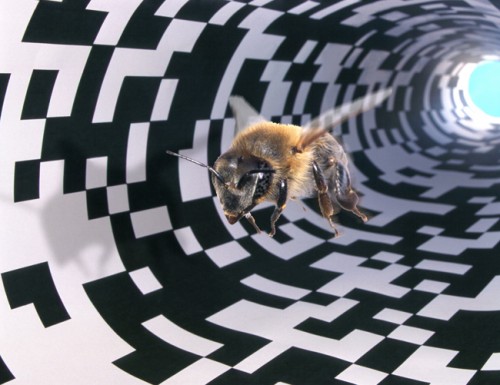
Researchers can trick a honey bee into thinking she has traveled a longer or shorter distance through a tunnel that leads to a food source by varying the pattern on the tunnel walls. A busy pattern, as seen here, is perceived as a longer distance than a sparse pattern.
CHAMPAIGN, lll. Tricking honey bees into thinking they have traveled long distance to find food alters gene expression in their brains, researchers report this month. Their study, in the journal Genes, Brain and Behavior, is the first to identify distance-responsive genes. Foraging honey bees make unique research animals in part because they communicate in a language humans can decode, said University of Illinois entomology and neuroscience professor Gene Robinson, who led the study. After a successful hunt, a forager performs a highly stylized 'dance' that tells her peers what direction to go to find the food, how good it is and how far away it is. The bee does a 'round dance' if the food is close to home, while a 'waggle dance' indicates it is farther away. (You can watch a video of activity in the honey bee hive, including the dances here.
TO READ THIS ARTICLE, CREATE YOUR ACCOUNT
And extend your reading, free of charge and with no commitment.