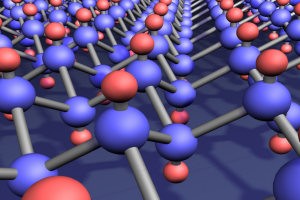
Fluorographene, created at The University of Manchester
University of Manchester scientists have created a new material which could replace or compete with Teflon in thousands of everyday applications. Professor Andre Geim, who along with his colleague Professor Kostya Novoselov won the 2010 Nobel Prize for graphene - the world's thinnest material, has now modified it to make fluorographene - a one-molecule-thick material chemically similar to Teflon. Fluorographene is fully-fluorinated graphene and is basically a two-dimensional version of Teflon, showing similar properties including chemical inertness and thermal stability. The results are this week reported in the advanced online issue of the journal Small. The work is a large international effort and involved research groups from China, the Netherlands, Poland and Russia. The team hope that fluorographene, which is a flat, crystal version of Teflon and is mechanically as strong as graphene, could be used as a thinner, lighter version of Teflon, but could also be in electronics, such as for new types of LED devices. Graphene, a one-atom-thick material that demonstrates a huge range of unusual and unique properties, has been at the centre of attention since groundbreaking research carried out at The University of Manchester six years ago.
TO READ THIS ARTICLE, CREATE YOUR ACCOUNT
And extend your reading, free of charge and with no commitment.