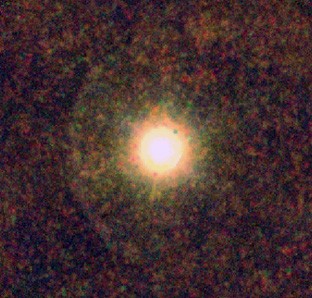
The red giant carbon star CW Leonis as seen by the PACS and SPIRE cameras on board Herschel. Credit: ESA/PACS/SPIRE/MESS Consortia.
Astronomers at UCL, using the European Space Agency's Herschel Space Observatory, have observed water vapour being formed somewhere it was previously thought to be impossible: in the atmosphere of a red giant carbon star. The major building blocks of life on Earth are water and carbon-based molecules, both of which are synthesised in large quantities by stars like the Sun as they reach the end of their lives. When they age, these stars become red giants and puff out their atmospheres. These atmospheres have previously been seen to contain either water molecules or carbon-based molecules, and it was thought that these two types of molecules could not co-exist. New results published today in Nature, from spectrometers onboard the Herschel Space Observatory, have overturned this longstanding concept by detecting abundant water vapour in the atmosphere of a very carbon-rich red giant star, called CW Leonis. Professor Mike Barlow, from UCL's department of Physics and Astronomy, and co-author of the paper said: "The detection of water vapour lines from the outflowing wind of a carbon star has required a complete re-evaluation of our models for the chemical processes in such outflows and testifies to the exceptional capabilities of the spectrometers on-board the Herschel Space Observatory." "The abundances are high in all the excitation lines, you can call it water vapour and it's everything from cool, to warm, to hot - right up to levels where you need temperatures of 1,000 kelvin or so (725C)," he added.
TO READ THIS ARTICLE, CREATE YOUR ACCOUNT
And extend your reading, free of charge and with no commitment.