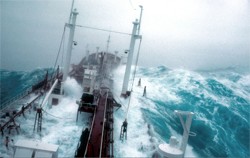
 An image from the chemical tanker ship Stolt Surf, built in 1970, caught in a large storm in the North Pacific Ocean in 1977. The largest waves of the storm broke over the Bridge, more than 22 metres high.
State-of-the-art optical fibre technology and a 27 year old mathematical theory have been used to demonstrate how extreme events occur - from financial disasters to rogue waves and stampedes - according to researchers from The Australian National University. An international team of researchers, including Professor Nail Akhmediev from the ANU Research School of Physical Sciences and Engineering, have observed the well-known mathematical prediction, 'Peregrine's Soliton', for the first time. Named after British scientist Howell Peregrine, this theoretical result describes how giant, nonlinear water waves can both grow and decline extremely quickly. The observation was made not in water, however, but in intense light pulses in optical fibres. The outcome, which was a near-perfect representation of Peregrine's prediction, could shed new light on the frequency of seemingly extreme events in both the natural and man-made world. The researchers' paper on the subject is published. 'Having observed this effect in optical fibres it can serve as a prototype for a wide range of extreme events in nature and social life such as financial disasters, ocean rogue waves, stampedes, climate catastrophes and a variety of other cataclysms,' said Professor Akhmediev.
TO READ THIS ARTICLE, CREATE YOUR ACCOUNT
And extend your reading, free of charge and with no commitment.
Your Benefits
- Access to all content
- Receive newsmails for news and jobs
- Post ads