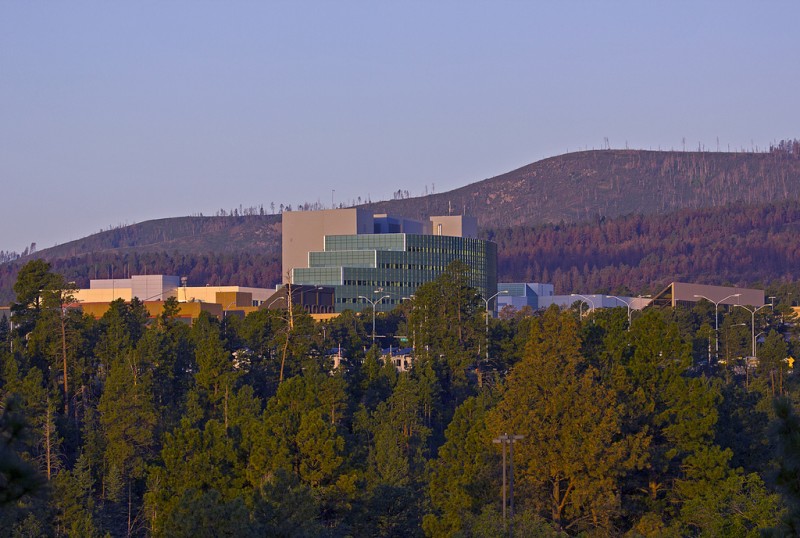
Los Alamos National Laboratory sits on top of a once-remote mesa in northern New Mexico with the Jemez mountains as a backdrop to research and innovation covering multi-disciplines from bioscience, sustainable energy sources, to plasma physics and new materials.
LANL Ion Beam Materials Lab helps confirm that the moon is bone dry LOS ALAMOS, New Mexico, AUGUST 5, 2010—A team of scientists used an ion beam in a basement room at Los Alamos National Laboratory to simulate solar winds on the surface of the Moon. The table-top simulation helped confirm that the Moon is inherently dry. In research published today in Science Express , Zachary Sharp of the University of New Mexico and a team of scientists from California, Texas and New Mexico—including Yongqiang Wang, leader of Los Alamos' Ion Beam Materials Lab—present an analysis of chlorine isotopic ratios in lunar rock samples that seem to indicate that the Moon never had water of its own. Many scientists believe that the Moon formed when a large object collided with Earth early in its formative stages, leaving behind a blob of material that became trapped in orbit around the nascent Earth. Because most of the water on Earth likely came from water liberated from molten basalts as they cooled, researchers have often wondered whether the Moon's geology contains similar concentrations of trapped water. Sharp and his team examined ratios of stable chlorine isotopes—chlorine-35 and chlorine-37—in terrestrial and lunar rock samples. Chlorine readily interacts with hydrogen and is highly volatile.
TO READ THIS ARTICLE, CREATE YOUR ACCOUNT
And extend your reading, free of charge and with no commitment.