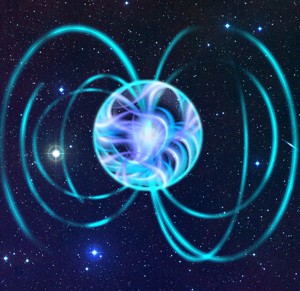
An artistic impression of a magnetar with a very
complicated magnetic field at its interior and a simple small dipolar field
outside Credit: ESA, Christophe Carreau
Dramatic flares and bursts of energy - activity previously thought reserved for only the strongest magnetized pulsars - have been observed emanating from a weakly magnetised, slowly rotating pulsar. The international team of astrophysicists who made the discovery believe that the source of the pulsar's power may be hidden deep within its surface. Pulsars, or neutron stars, are the collapsed remains of massive stars. Although they are on average only about 30km in diameter, they have hugely powerful surface magnetic fields, billions of times that of our Sun. The most extreme kind of pulsars have a surface magnetic field 50-1000 times stronger than normal and emit powerful flares of gamma rays and X-rays. Named magnetars (which stands for "magnetic stars") by astronomers, their huge magnetic fields are thought to be the ultimate source of power for the bursts of gamma rays. Theoretical studies indicate that in magnetars the internal field is actually stronger than the surface field, a property which can deform the crust and spread outwards.
TO READ THIS ARTICLE, CREATE YOUR ACCOUNT
And extend your reading, free of charge and with no commitment.