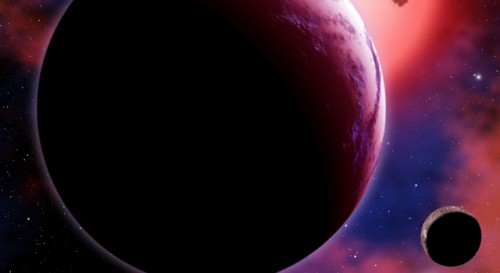
The planet GJ 1214b, shown here in an artist’s conception with
two hypothetical moons, orbits a "red dwarf" star 40 light-years from Earth. Image credit: CfA/David Aguilar
PASADENA, Calif. A team of astronomers, including two NASA Sagan Fellows, has made the first characterizations of a super-Earth's atmosphere, by using a ground-based telescope. A super-Earth is a planet up to three times the size of Earth and weighing up to 10 times as much. The findings, reported in the Dec. 2 issue of the journal Nature, are a significant milestone toward eventually being able to probe the atmospheres of Earth-like planets for signs of life. The team determined the planet, GJ 1214b, is either blanketed with a thin layer of water steam or surrounded by a thick layer of high clouds. If the former, the planet itself would have an icy composition.
TO READ THIS ARTICLE, CREATE YOUR ACCOUNT
And extend your reading, free of charge and with no commitment.