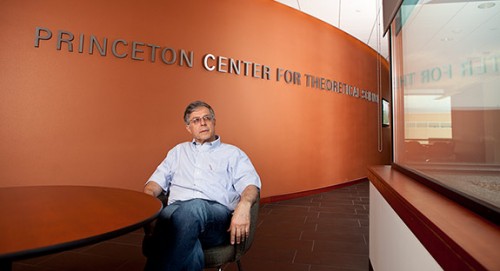
Car, who also is a faculty fellow of the Princeton Center for Theoretical Science, draws inspiration for his research from his experiences as a youth in Italy following World War II. "There was this powerful sentiment among people that one could rebuild and forge a better society," he said. "It gave me a belief in progress." Solving difficult problems is only possible, he adds, if researchers can set their imaginations free.
Name: Roberto Car Title: The Ralph W. Dornte *31 Professor in Chemistry and a faculty fellow of the Princeton Center for Theoretical Science Scholarly focus: Car co-developed "ab-initio molecular dynamics," a theory that has had an enormous impact on the creation of molecular simulations with useful applications in all the basic sciences. This approach, which also goes under the name of the Car-Parrinello method, represented a milestone in computational physics and has dramatically influenced the methodology behind electronic structure calculations for solids, liquids and molecules. He has won several awards for his significant contributions to science, including the Dirac Medal, the Humboldt Award and the IEEE Computer Society's Sidney Fernbach Award. Background: Car came to Princeton in 1999 after working at the University of Milan, the Swiss Federal Institute of Technology in Lausanne, the IBM T.J. Watson Research Center in New York, the International School for Advanced Studies in Trieste, Italy, and the University of Geneva. You have a passion for your work, for science. What's the source of that drive? It started early for me. I was born in Trieste (then briefly an independent city-state - ceded back to Italy in 1954) after World War II, and grew up there until we moved to Milan.
TO READ THIS ARTICLE, CREATE YOUR ACCOUNT
And extend your reading, free of charge and with no commitment.