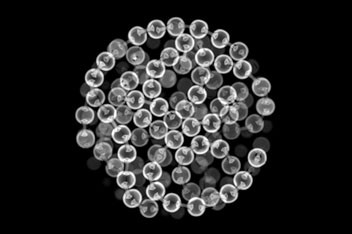
Partial three-dimensional reconstruction, from X-ray tomographic data, of the packing of 2.1-mm ball chains, projected onto a plane. When tightly packed, the chains form nearly circular rigid loops, like the one in the lower right of the image. This behavior may form the basis of a model for better predictions of the rigidity of polymers. (Ling-Nan Zou and Mark L. Rivers, The University of)
Sometimes the simplest things hold the key to understanding complex effects. It turns out that a humble metal pull-chain'just like those used on ceiling fans'can be a pretty good model for complex properties of polymer materials. A group of University of Chicago researchers used X-ray microtomography to study what - happens when beaded metal chains are packed more and more tightly into a container. The results look similar to those obtained when a polymer becomes rigid, the difference between molten and hard plastic. Both naturally occurring and synthetic, polymers are large, chain-like molecules found in plastics, rubber and a variety of other substances. With this pull-chain model, the behavior of individual 'molecules' can be studied in a way that is impossible with real polymers. 'We were looking for new ways to study how particles pack into stable structures,' said Ling-Nan Zou, PhD?09, lead author of a paper that appeared in the Oct.
TO READ THIS ARTICLE, CREATE YOUR ACCOUNT
And extend your reading, free of charge and with no commitment.