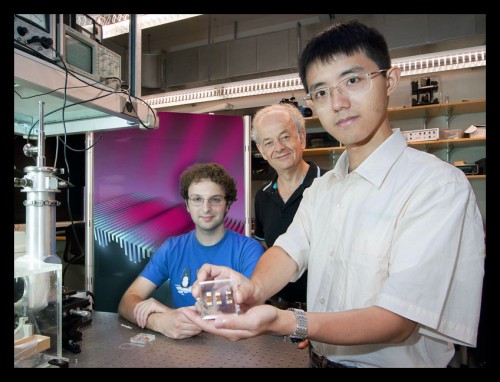
Researchers Mikhail A. Kats, Federico Capasso, and Nanfang Yu show their ability to sculpt
an artificial optical structure on the facet of a laser.
Advance in metamaterials leads to a new semiconductor laser suitable for security screening, chemical sensing and astronomy. A collaborative team of scientists at Harvard and the University of Leeds have demonstrated a new terahertz (THz) semiconductor laser that emits beams with a much smaller divergence than conventional THz laser sources. The advance opens the door to a wide range of applications in terahertz science and technology. Harvard has filed a broad patent on the invention. The finding was spearheaded by postdoctoral fellow Nanfang Yu and Federico Capasso , the Robert L. Wallace Professor of Applied Physics and - Vinton Hayes Senior Research Fellow in Electrical Engineering, both of Harvard's School of Engineering and Applied Sciences (SEAS), and by a - team led by Edmund Linfield at the School of Electronic and Electrical Engineering, University of Leeds. Terahertz rays (T-rays) can penetrate efficiently through paper, clothing, plastic, and many other materials, making them ideal for detecting concealed weapons and biological agents, imaging tumors without harmful side effects, and spotting defects, such as cracks, within materials. THz radiation is also used for high-sensitivity detection of tiny concentrations of interstellar chemicals.
TO READ THIS ARTICLE, CREATE YOUR ACCOUNT
And extend your reading, free of charge and with no commitment.