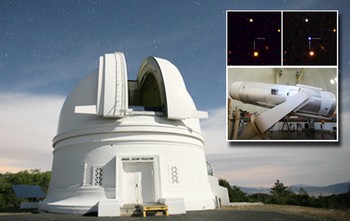
The 1.2-meter Samuel Oschin Telescope at Palomar Observatory that was used to discover four supernovae of a new class. Inset: one of the newly discovered supernovae, PTF09cnd.
PASADENA, Calif.—They're bright and blue—and a bit strange. They're a new type of stellar explosion that was recently discovered by a team of astronomers led by the California Institute of Technology (Caltech). Among the most luminous in the cosmos, these new kinds of supernovae could help researchers better understand star formation, distant galaxies, and what the early universe might have been like. "We're learning about a whole new class of supernovae that wasn't known before," says Robert Quimby, a Caltech postdoctoral scholar and the lead author on a paper to be published in the June 9 issue of the journal Nature . In addition to finding four explosions of this type, the team also discovered that two previously known supernovae, whose identities had baffled astronomers, also belonged to this new class. Quimby first made headlines in 2007 when—as a graduate student at the University of Texas, Austin—he discovered what was then the brightest supernova ever found: 100 billion times brighter than the sun and 10 times brighter than most other supernovae. Dubbed 2005ap, it was also a little odd.
TO READ THIS ARTICLE, CREATE YOUR ACCOUNT
And extend your reading, free of charge and with no commitment.