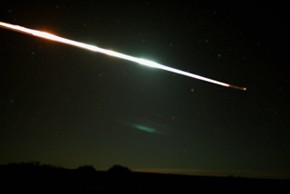
Hayabusa re-entering the atmosphere
Early results from analysis of dust on the Hayabusa space capsule, which landed in South Australia last year, have revealed an indisputable link between the asteroids we see in space and meteorites that we collect on land. Published recently in Science, six papers on the findings of the Hayabusa mission provided samples of a pristine asteroid, known as Itokawa. Earth Chemistry Professor Trevor Ireland from The Australian National University is a coauthor of four of the papers, and said the dust contained an exciting message. "Previously there had been problems relating the nature of asteroids with meteorites because the surfaces of meteorites are destroyed as they come in through the atmosphere," he said. "The samples taken from Itokawa are the previously unknown 'skin' of an asteroid and their investigation has confirmed that meteorites that land on Earth are indeed related to the asteroids we see in space." The Hayabusa Mission involved two touchdowns on the asteroid. Professor Ireland noted that the original intent was for a gun to fire into the surface of Itokawa when Hayabusa touched down, with the ejected sample collected into the chamber, but a software interlock prevented the gun from firing. "This was fairly disappointing in that we didn't get as much material returned as was intended, which would have provided us with a bulk sample of the asteroid to analyse," he said. "In hindsight though, a bulk sample would not necessarily have provided the same information as we have obtained from these small dust grains that sat on the very surface of the asteroid.
TO READ THIS ARTICLE, CREATE YOUR ACCOUNT
And extend your reading, free of charge and with no commitment.