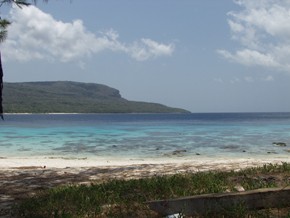
Many caves and rockshelter - such as Jerimalai - are located in the uplifted Pleistocene limestone terraces at the east end of East Timor.
An archaeologist from The Australian National University has uncovered the world's oldest evidence of deep sea fishing for big fish, showing that 42,000 years ago our regional ancestors had mastered one of our nation's favourite pastimes. Professor Sue O'Connor of the College of Asia and the Pacific at ANU, also found the world's earliest recorded fish hook in her excavations at a site in East Timor. The results of this work are published . The finds from the Jerimalai cave site demonstrate that 42,000 years ago our regional ancestors had high-level maritime skills, and by implication the technology needed to make the ocean crossings to reach Australia. "The site that we studied featured more than 38,000 fish bones from 2,843 individual fish dating back 42,000 years," said Professor O'Connor. "What the site in East Timor has shown us is that early modern humans in Island Southeast Asia had amazingly advanced maritime skills. They were expert at catching the types of fish that would be challenging even today - fish like tuna.
TO READ THIS ARTICLE, CREATE YOUR ACCOUNT
And extend your reading, free of charge and with no commitment.