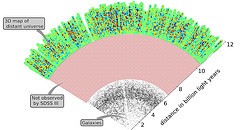
A 2-D illustration of a slice through the new 3-D map of the universe. Click on the image above for more information.
Scientists from the Sloan Digital Sky Survey (SDSS-III) collaboration, including an astronomer at Penn State, have created the largest-ever three-dimensional map of the distant universe by using the light of the brightest objects in the cosmos to illuminate ghostly clouds of intergalactic hydrogen. The map provides an unprecedented view of how the universe looked 10 billion years ago. The new research achievement is being presented today at a meeting of the American Physical Society and is described in a scientific article posted on an astrophysics preprint server ( arxiv.org/archive/astro-ph ). "The novel approach employed by this investigation has great promise for future studies of the conditions present in the early universe," said Donald Schneider, distinguished professor of astronomy and astrophysics at Penn State and a coauthor of the study. Schneider is the Survey Coordinator of the large, international SDSS-III collaboration. The new technique turns the standard approach of astronomy on its head, explained Anze Slosar, a physicist at the U.S. Department of Energy's Brookhaven National Laboratory who led this research study. "Usually we make our maps of the universe by looking at galaxies, which emit light.
TO READ THIS ARTICLE, CREATE YOUR ACCOUNT
And extend your reading, free of charge and with no commitment.