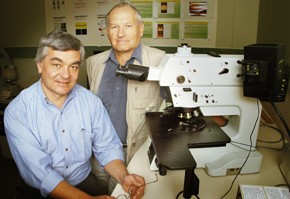
Professor Andrei Rode in the lab with colleague Dr Eugine Gamaly. Photo: Tim Wetherell
An international team of researchers including scientists from The Australian National University have created a new, super-dense version of aluminium that could lead to efficient production of new super-hard nanomaterials at a relatively low cost.In a paper published today in Nature , the group has described how they discovered a way to produce body-centred-cubic aluminium, which is 40 per cent more dense. Super-hard aluminium was predicted to exist more than 30 years ago but has never before been observed.Professor Andrei Rode from the Laser Physics Centre at ANU said the state of any material depends on temperature and pressure. 'For example, water turns into ice at low temperatures and hydrogen gas actually becomes metallic under extreme pressure in the middle of a star,' he said. 'Lab experiments on producing high pressure and temperature generally use a diamond anvil with a point on one end to produce high pressure but this is limited by the strength of the diamond, which in the case of aluminium, is not hard enough to crush into a new state. 'We demonstrated that it is possible to create extreme pressure and temperature conditions in table-top laboratory experiments using an extremely short laser pulse to create a huge concentration of energy in a very short time and in a very small sub-micron volume inside a sapphire crystal, which is aluminium oxide. 'This experiment resulted in something like a micro-explosion which turned the aluminium to a plasma state that swelled but had nowhere else to go, creating gigantic pressure and dramatic changes in surrounding material properties and producing unfamiliar x-ray spectral lines.
TO READ THIS ARTICLE, CREATE YOUR ACCOUNT
And extend your reading, free of charge and with no commitment.