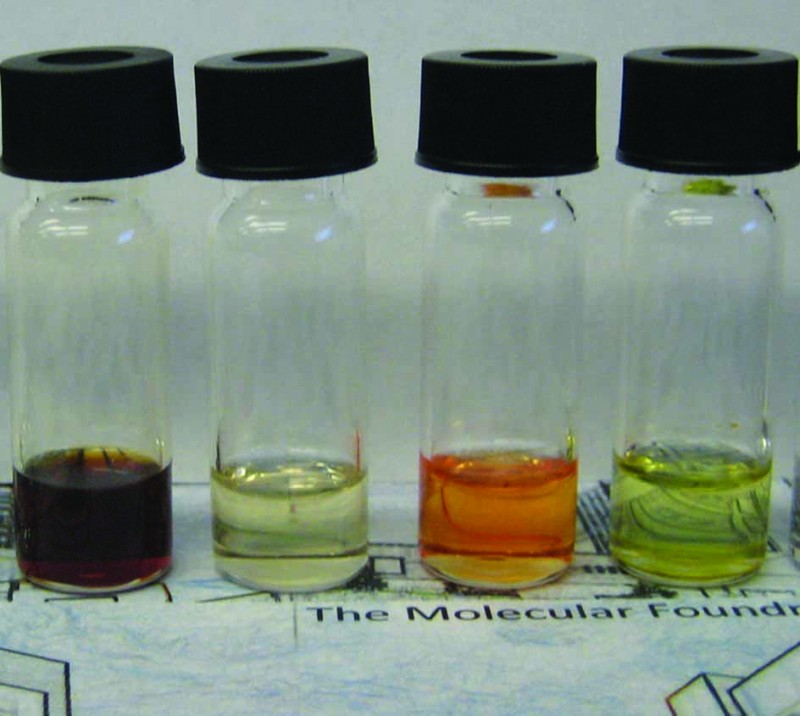
Vials of ligand-free nanocrystals dispersed in solution for various applications, including energy storage, smart windows and LEDs.
Researchers with the U.S. Department of Energy (DOE)'s Lawrence Berkeley National Laboratory (Berkeley Lab) have discovered a universal technique for stripping nanocrystals of tether-like molecules that until now have posed as obstacles for their integration into devices. These findings could provide scientists with a clean slate for developing new nanocrystal-based technologies for energy storage, photovoltaics, smart windows, solar fuels and light-emitting diodes. Nanocrystals are typically prepared in a chemical solution using stringy molecules called ligands chemically tethered to their surface. These hydrocarbon-based or organometallic molecules help stabilize the nanocrystal, but also form an undesirable insulating shell around the structure. Efficient and clean removal of these surface ligands is challenging and has eluded researchers for decades. Now, using Meerwein's salt-an organic compound also known by its tongue twisting moniker triethyloxonium tetrafluoroborate-a Berkeley Lab team has stripped away organic ligands tethered to nanocrystals, exposing a bare surface enabling nanocrystals to be used in a variety of applications.
TO READ THIS ARTICLE, CREATE YOUR ACCOUNT
And extend your reading, free of charge and with no commitment.