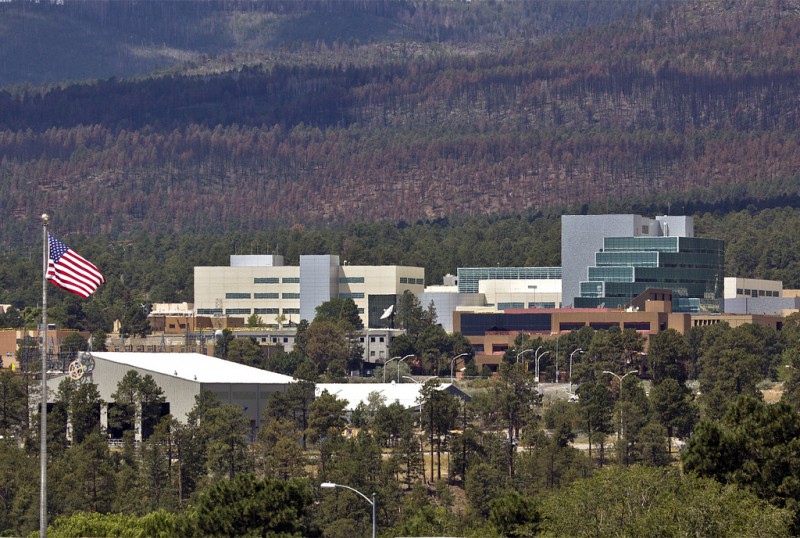
Los Alamos National Laboratory sits on top of a once-remote mesa in northern New Mexico with the Jemez mountains as a backdrop to research and innovation covering multi-disciplines from bioscience, sustainable energy sources, to plasma physics and new materials.
Potential pretreatment method that can make plant cellulose five times more digestible by enzymes that convert it into ethanol, a useful biofuel. LANL molecular model helps expose cellulose weakness LOS ALAMOS, New Mexico, July 20, 2011—Researchers at the U.S. Department of Energy's Los Alamos National Laboratory and Great Lakes Bioenergy Research Center have found a potential key for unlocking the energy potential from non-edible biomass materials such as corn leaves and stalks, or switch grass. In a paper appearing in today's Journal of the American Chemical Society, Los Alamos researchers S. Gnanakaran, Giovanni Bellesia, and Paul Langan join Shishir Chundawat and Bruce Dale of Michigan State University, and collaborators from the Great Lakes Bioenergy Research Center in describing a potential pretreatment method that can make plant cellulose five times more digestible by enzymes that convert it into ethanol, a useful biofuel. Biomass is a desirable renewable energy source because fermentable sugars within the cellulose network of plant cells can be extracted with enzymes and then converted into ethanol—if only it were so simple. One of the key difficulties in creating biofuels from plant matter is that the cellulose tends to orient itself into a sheet-like network of highly ordered, densely packed molecules. These sheets stack upon themselves and bond together very tightly due to interactions between hydrogen atoms—somewhat like sheets of chicken wire stacked together and secured by loops of bailing wire.
TO READ THIS ARTICLE, CREATE YOUR ACCOUNT
And extend your reading, free of charge and with no commitment.