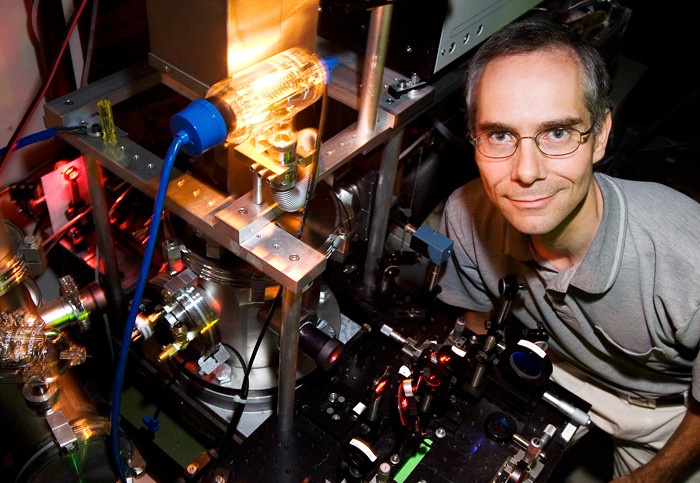
Chemistry professor Martin Gruebele led a group that directly observed two-state dynamics I nglassy silicon for the first time.
CHAMPAIGN, Ill. Using high-resolution imaging technology, University of Illinois researchers have answered a question that had confounded semiconductor researchers: Is amorphous silicon a glass? The answer? Yes - until hydrogen is added. Led by chemistry professor Martin Gruebele, the group published its results in the journal Physical Review Letters. Amorphous silicon (a-Si) is a semiconductor popular for many device applications because it is inexpensive and can be created in a flexible thin film, unlike the rigid, brittle crystalline form of silicon. But the material has its own unusual qualities: It seems to have some characteristics of glass, but cannot be made the way other glasses are. Most glasses are made by rapidly cooling a melted material so that it hardens in a random structure. But cooling liquid silicon simply results in an orderly crystal structure.
TO READ THIS ARTICLE, CREATE YOUR ACCOUNT
And extend your reading, free of charge and with no commitment.