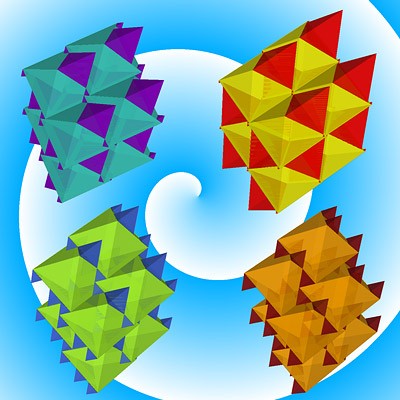
Filling three-dimensional space with multi-sided objects other than cubes is an old problem that is the subject of recent research by Princeton chemist Salvatore Torquato, whose team has found a solution by "tiling" together solid figures known as tetrahedra (with four triangular faces) and octahedra (with eight triangular faces). Shown here are members of a new infinite family of such space-filling structures. (Image courtesy of Salvatore Torquato)
by Gale Scott Whether packing oranges into a crate, fitting molecules into a human cell or getting data onto a compact disc, wasted space is usually not a good thing. Now, in findings published June 20 in the Proceedings of the National Academy Sciences, Princeton University chemist Salvatore Torquato and colleagues have solved a conundrum that has baffled mathematical minds since ancient times - how to fill three-dimensional space with multi-sided objects other than cubes without having any gaps. The discovery could lead to scientists finding new materials and could lead to advances in systems and computer security. "You know you can fill space with cubes," Torquato said, "We were looking for another way." In the article "New Family of Tilings of Three-Dimensional Euclidean Space by Tetrahedra and Octahedra," he and his team show they have solved the problem. Torquato, who is a professor in the Department of Chemistry , Princeton Institute for the Science and Technology of Materials and Princeton Center for Theoretical Science, worked with Yang Jiao, a postdoctoral associate at Princeton, and John Conway, Princeton's John Von Neumann Professor in Applied and Computational Mathematics, to find that three-dimensional space can be efficiently filled with units consisting of an octahedron and six smaller tetrahedra. Moreover, the resulting patterns can be repeated infinitely. The researchers' work involves "tiling," also known as "tessellation" after the Latin word "tessella," meaning a small cube or tile.
TO READ THIS ARTICLE, CREATE YOUR ACCOUNT
And extend your reading, free of charge and with no commitment.