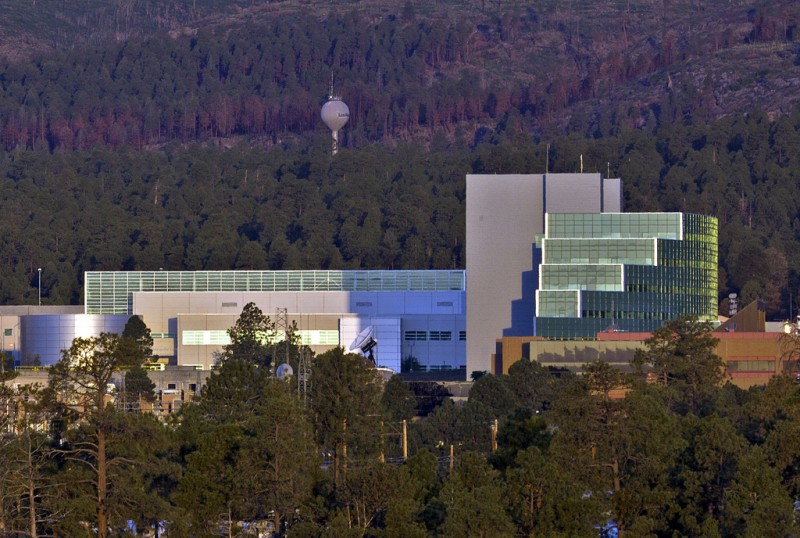
Los Alamos National Laboratory sits on top of a once-remote mesa in northern New Mexico with the Jemez mountains as a backdrop to research and innovation covering multi-disciplines from bioscience, sustainable energy sources, to plasma physics and new materials.
A research team has harnessed neutrons to view for the first time the critical role that an elusive molecule plays in certain biological reactions. LOS ALAMOS, New Mexico, August 8, 2011—A Los Alamos National Laboratory research team has harnessed neutrons to view for the first time the critical role that an elusive molecule plays in certain biological reactions. The effort could aid in treatment of peptic ulcers or acid reflux disease, or allow for more efficient conversion of woody waste into transportation fuels. In a paper appearing this week in Angewandte Chemie International Edition, Los Alamos researchers join an international team in describing the role played by the elusive hydronium ion in the transfer of protons during enzyme-catalyzed reactions. Prior to this research, no one has ever directly witnessed the role of the hydronium ion, a water molecule bound to an additional hydrogen ion, in macromolecular catalysts—the catalytic mechanisms of enzymes. Researchers took an interest in an enzyme that has the potential to allow conversion of sugars in woody biomass into alcohol, a potential alternative fuel, because the enzyme loses its effectiveness when the pH value of the milieu is lowered—a common occurrence in the interior of industrial yeast cells fermenting alcohol. As it turns out, this biochemical reaction also has ramifications for the activation of proton pumps in the stomach, which produces excess acid in those afflicted by gastric diseases.
TO READ THIS ARTICLE, CREATE YOUR ACCOUNT
And extend your reading, free of charge and with no commitment.