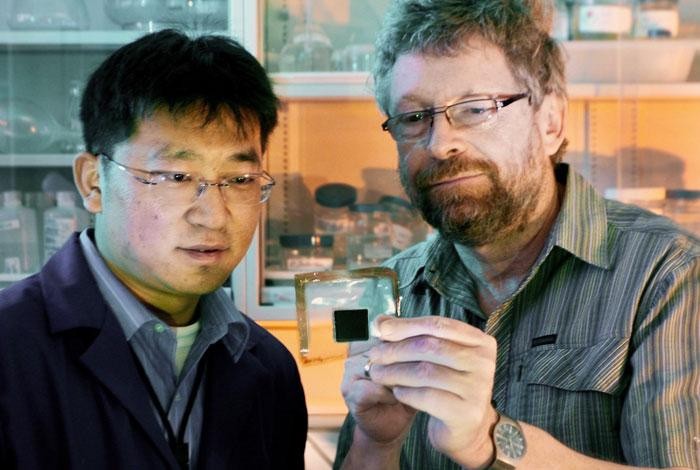
Los Alamos National Laboratory researchers Gang Wu, left, and Piotr Zelenay examine a new non-precious-metal catalyst that can significantly reduce the cost of hydrogen fuel cells while maintaining performance.
Laboratory scientists have developed a way to avoid the use of expensive platinum in hydrogen fuel cells. Los Alamos scientists document utility of non-precious-metal catalysts LOS ALAMOS, New Mexico, April 22, 2011—Los Alamos National Laboratory scientists have developed a way to avoid the use of expensive platinum in hydrogen fuel cells, the environmentally friendly devices that might replace current power sources in everything from personal data devices to automobiles. In a paper published today in Science, Los Alamos researchers Gang Wu, Christina Johnston, and Piotr Zelenay, joined by researcher Karren More of Oak Ridge National Laboratory, describe the use of a platinum-free catalyst in the cathode of a hydrogen fuel cell. Eliminating platinum—a precious metal more expensive than gold—would solve a significant economic challenge that has thwarted widespread use of large-scale hydrogen fuel cell systems. Polymer-electrolyte hydrogen fuel cells convert hydrogen and oxygen into electricity. The cells can be enlarged and combined in series for high-power applications, including automobiles. Under optimal conditions, the hydrogen fuel cell produces water as a "waste" product and does not emit greenhouse gasses.
TO READ THIS ARTICLE, CREATE YOUR ACCOUNT
And extend your reading, free of charge and with no commitment.