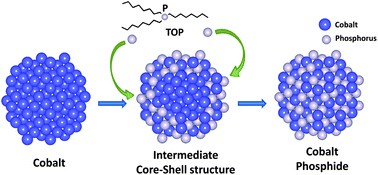
The evolution schematics of transition from cobalt to cobalt phosphide nanocrystals.
Understanding the intricacies of how nanoparticles undergo chemical transformations could lead to better ways to tailor their composition, which can lead to advanced material properties. Using the Cornell High Energy Synchrotron Source, scientists led by Richard Robinson, assistant professor of materials science and engineering, uncovered exactly what happens when cobalt nanoparticles transform into two phases of cobalt phosphides. Their work, published in the Journal of Materials Chemistry, was featured by the journal as a "Hot Article" earlier this month. The effect Robinson's team observed in the cobalt phosphide transitions was a nanoparticle hollowing due to asymmetric diffusivities of cations and anions. In other words, the cations move out from the core faster than anions can diffuse in, leading to a hollow particle. Other groups have reported on this "Kirkendall" effect, but the Robinson team was the first to show that this hollowing is more complex than previously thought and can be studied as a two-step process. Their work could be used to control this process and produce complex particles with properties tailored for use in energy applications.
TO READ THIS ARTICLE, CREATE YOUR ACCOUNT
And extend your reading, free of charge and with no commitment.