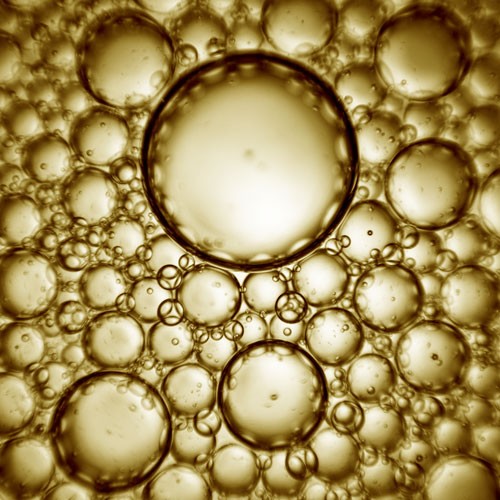
Researchers at Harvard have discovered that the properties of emulsions cannot be characterized simply by Young’s law. Image courtesy of Flickr user Daniel Kulinski (color added).
Physical equilibrium, assumed to be almost instant, may take months or years for particles in oil-water mixtures. By studying the behavior of tiny particles at an interface between oil and water, researchers at Harvard have discovered that stabilized emulsions may take longer to reach equilibrium than previously thought. Much longer, in fact. "We were looking at what we thought would be a very simple phenomenon, and we found something very strange," says principal investigator Vinothan Manoharan, Associate Professor of Chemical Engineering and Physics at the Harvard School of Engineering and Applied Sciences (SEAS). "We knew that the particle would stick to the interface, and other researchers had assumed this event happened instantaneously," he says. "We actually found that the timescale for this process was months to years." The findings, published (online) on December 4, have important implications for the manufacturing processes used in pharmaceuticals, cosmetics, and foods, among other chemical industries. An emulsion is a mixture of two or more insoluble liquids-usually oil and water.
TO READ THIS ARTICLE, CREATE YOUR ACCOUNT
And extend your reading, free of charge and with no commitment.