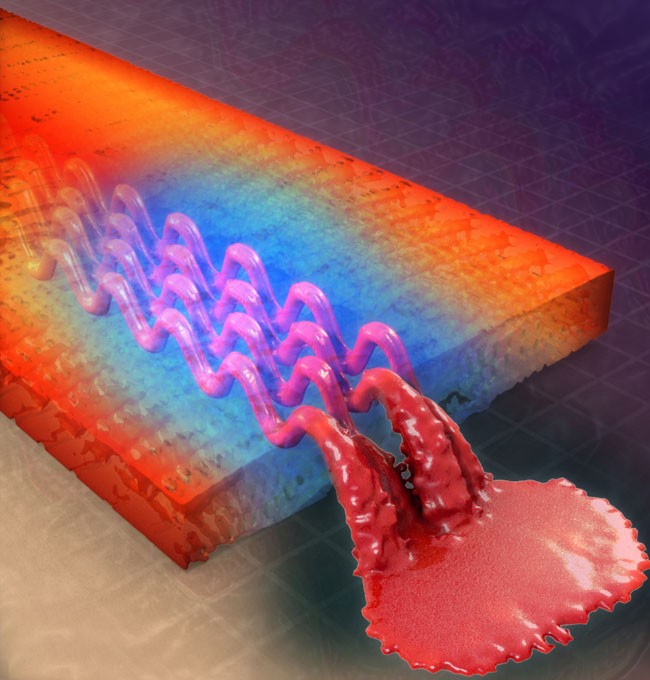
A vascularized fiber-reinforced composite material. Illinois researchers developed a class of sacrificial fibers that degrade after composite fabrication, leaving hollow vascular tunnels that can transport liquids or gases through the composite.
CHAMPAIGN, Ill. Taking their cue from biological circulatory systems, University of Illinois researchers have developed vascularized structural composites, creating materials that are lightweight and strong with potential for self-healing, self-cooling, metamaterials and more. "We can make a material now that's truly multifunctional by simply circulating fluids that do different things within the same material system," said Scott White, the Willet Professor of aerospace engineering who led the group. "We have a vascularized structural material that can do almost anything." Composite materials are a combination of two or more materials that harness the properties of both. Composites are valued as structural materials because they can be lightweight and strong. Many composites are fiber-reinforced, made of a network of woven fibers embedded in resin - for example, graphite, fiberglass or Kevlar. The Illinois team, part of the Autonomous Materials Systems Laboratory in the Beckman Institute for Advanced Science and Technology, developed a method of making fiber-reinforced composites with tiny channels for liquid or gas transport.
TO READ THIS ARTICLE, CREATE YOUR ACCOUNT
And extend your reading, free of charge and with no commitment.