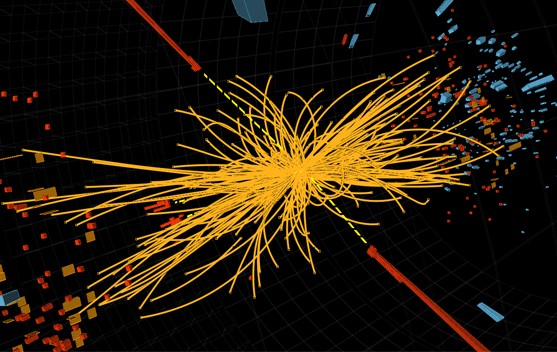
 A proton-proton collision event in the CMS experiment producing two high-energy photons (red towers). This is what we would expect to see from the decay of a Higgs boson but it is also consistent with background Standard Model physics processes.
Geneva, 4 July 2012. At a seminar held at CERN today as a curtain raiser to the year's major particle physics conference, ICHEP2012 in Melbourne, the ATLAS and CMS experiments presented their latest preliminary results in the search for the long sought Higgs particle. Both experiments observe a new particle in the mass region around 125-126 GeV. "We observe in our data clear signs of a new particle, at the level of 5 sigma, in the mass region around 126 GeV. The outstanding performance of the LHC and ATLAS and the huge efforts of many people have brought us to this exciting stage," said ATLAS experiment spokesperson Fabiola Gianotti, "but a little more time is needed to prepare these results for publication." "The results are preliminary but the 5 sigma signal at around 125 GeV we're seeing is dramatic. This is indeed a new particle. We know it must be a boson and it's the heaviest boson ever found," said CMS experiment spokesperson Joe Incandela.
TO READ THIS ARTICLE, CREATE YOUR ACCOUNT
And extend your reading, free of charge and with no commitment.
Your Benefits
- Access to all content
- Receive newsmails for news and jobs
- Post ads