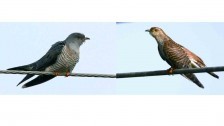
Grey morph and rufous morph Grey morph (left) copyright Pauline and Ian's Wildlife images
Rufous morph (right) copyright Mike Pope
When mimicry becomes less effective, evolving to look completely different can be a successful trick. Our research shows that individuals assess disguises not only from personal experience, but also by observing others. However, because their learning is so specific, this social learning then selects for alternative cuckoo disguises and the arms race continues." - —Dr Rose Thorogood, co-author on the paper from the Departement of Zoology To minimise the chance of being recognised and thus attacked by the birds they are trying to parasitize, female cuckoos have evolved different guises. The new research, funded by the Natural Environment Research Council, was published today, 03 August, in the journal Science. The common cuckoo ( Cuculus canorus ) lays its eggs in the nests of other birds. On hatching, the young cuckoo ejects the host's eggs and chicks from the nest, so the hosts end up raising a cuckoo chick rather than a brood of their own. To fight back, reed warblers (a common host across Europe) have a first line of defence: they attack, or 'mob', the female cuckoo, which reduces the chance that their nest is parasitized.
TO READ THIS ARTICLE, CREATE YOUR ACCOUNT
And extend your reading, free of charge and with no commitment.