Electrons Ripple Across Atom-Thin Layers of Carbon
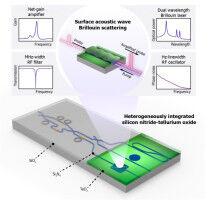
An infrared laser beam focused on the arm of an atomic-force microscope launches plasmons, waves through electrons, on the surface of graphene, a single honeycomb layer of linked carbon atoms. Credit: Basov Lab. With a beam of infrared light, scientists have sent ripples of electrons along the surface of graphene and demonstrated that they can control the length and height of these oscillations, called plasmons, using a simple electrical circuit. This is the first time anyone has observed plasmons on graphene, sheets of carbon just one atom thick with a host of intriguing physical properties, and an important step toward using plasmons to process and transmit information in spaces too tight to use light. "Everybody suspected that plasmons should be there, but seeing is believing. We've imaged them and shown that they propagate. And we've demonstrated that we can control them," said Dimitri Basov, professor of physics at the University of California, San Diego, and senior author of To make the devices, they peeled graphene from graphite, the stuff of pencil lead, and rubbed it onto silicon dioxide chips.