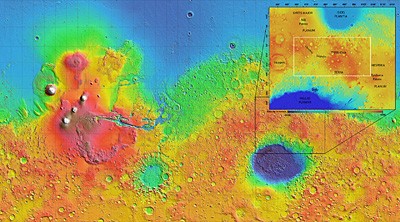
Tyrrhena Terra
Exhumed rocks reveal Mars water ran deep By studying rocks blasted out of impact craters, ESA's Mars Express has found evidence that underground water persisted at depth for prolonged periods during the first billion years of the Red Planet's existence. Impact craters are natural windows into the history of planetary surfaces - the deeper the crater, the further back in time you can probe. In addition, rocks blasted out during the impact offer a chance to study material that once lay hidden beneath the surface. In a new study, ESA's Mars Express and NASA's Mars Reconnaissance Orbiter zoomed in on craters in a 1000 x 2000 km region of the ancient southern highlands, called Tyrrhena Terra, to learn more about the history of water in this region. Focusing on the chemistry of rocks embedded in the crater walls, rims and central uplifts, as well as the surrounding exhumed material, scientists identified 175 sites bearing minerals formed in the presence of water. "The large range of crater sizes studied, from less than 1 km to 84 km wide, indicates that these hydrated silicates were excavated from depths of tens of metres to kilometres," says Damien Loizeau, lead author of the study. "The composition of the rocks is such that underground water must have been present here for a long period of time in order to have altered their chemistry." - While the material excavated by impacts appears to have been in close with water, there is little evidence for rocks on the surface lying between the craters in Tyrrhena Terra having been altered by water.
TO READ THIS ARTICLE, CREATE YOUR ACCOUNT
And extend your reading, free of charge and with no commitment.