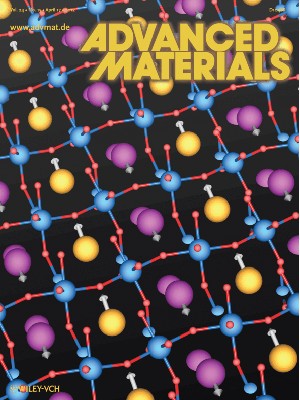
Engineered electric polarizations are indicated by the gray arrows, a "twisting-like" distortion of the corner-connected oxygen octahedral that is common to many perovskite oxides. First-principles calculations reveal that carefully designed atomic layering, represented by alternating gold and magenta spheres forming an atomic-scale superlattice, allows the octahedral rotations to induce ferroelectricity.
Some materials, by their nature, do what we want them to do - notably, the ubiquitous, semiconducting silicon found in almost every electronic device. But sometimes, naturally occurring materials need a little nudge - or in the case of recent Cornell research, a twist - to make them useful. Assistant professor of applied and engineering physics Craig Fennie and Drexel University's James Rondinelli have published a method for turning a class of ceramic materials called perovskites into a material that's ferroelectric. The work was published April 10 by Advanced Materials and also will be featured on the printed journal's inside cover. Ferroelectricity is a property in which a spontaneous electric polarization can be flipped by applying a small electric field, useful for low-power memory and switching devices. Traditional ferroelectric mechanisms, however, are often chemically incompatible with such phenomena as ferromagnetism, limiting their use in new types of multifunctional devices. The researchers' theory-only work, which employed density functional calculations, concluded that ferroelectricity in perovskites can be realized if their atomic structures are manipulated at the nanometer length scale and by slicing them only a few atoms thin, letting the natural twisting of their corner-shared octahedra - the basic structural unit of perovskite crystals - do the rest.
TO READ THIS ARTICLE, CREATE YOUR ACCOUNT
And extend your reading, free of charge and with no commitment.