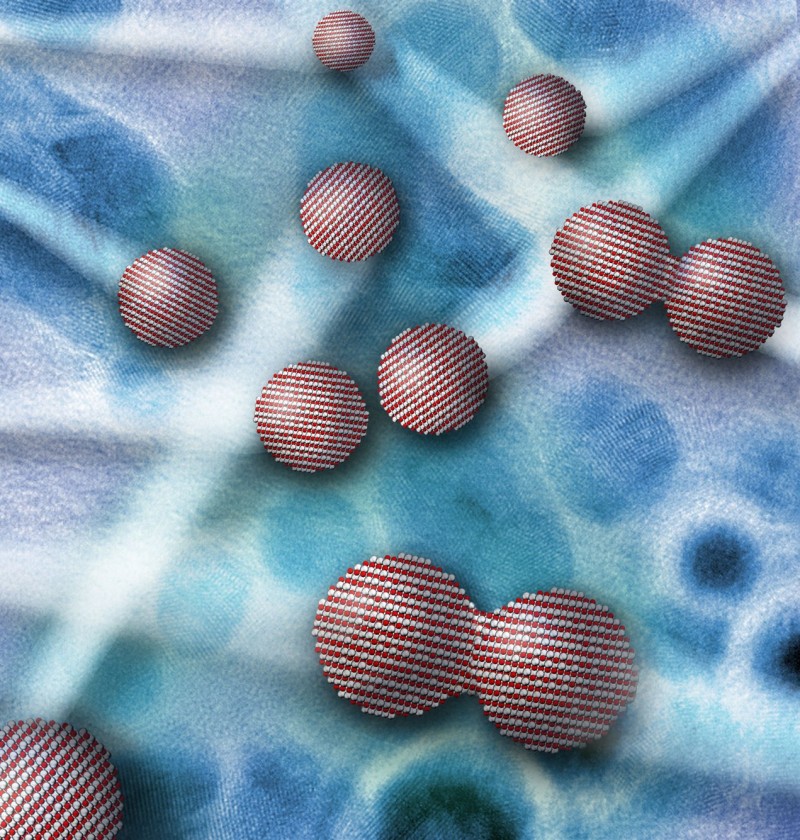
Berkeley Lab researchers at the Molecular Foundry have elucidated important mechanisms behind oriented attachment that drives biomineralization and the growth of nanocrystals. (Image from Jim DeYoreo)
This electron microscopy movie shows the early stage of nanocrystal growth. Nanoparticles make transient at many points and orientations until their lattices are perfectly matched. The particles then make a sudden jump-to- to form attached aggregates. (Movie courtesy of Jim DeYoreo) Through biomineralization, nature is able to produce such engineering marvels as mother of pearl, or nacre, the inner lining of abalone shells renowned for both its iridescent beauty and amazing toughness. Key to biomineralization is the phenomenon known as "oriented attachment," whereby adjacent nanoparticles connect with one another in a common crystallographic orientation. While the importance of oriented attachment to biomineral properties long has been recognized, the mechanism by which it occurs has remained a mystery. With a better understanding of oriented attachment it should be possible to synthesize new materials with remarkable structural properties.
TO READ THIS ARTICLE, CREATE YOUR ACCOUNT
And extend your reading, free of charge and with no commitment.