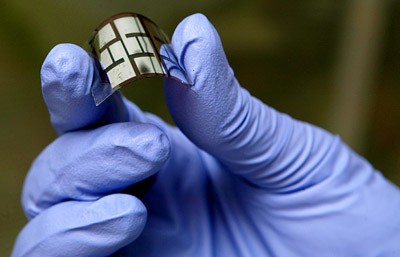
Yueh-Lin (Lynn) Loo, a Princeton of chemical and biological engineering, displays a sample of her team’s new photovoltaic cell, which is more efficient and tougher than traditional cells. (Photo by Frank Wojciechowski)
Taking their cue from the humble leaf, researchers have used microscopic folds on the surface of photovoltaic material to significantly increase the power output of flexible, low-cost solar cells. The team, led by scientists from Princeton University, reported Photonics that the folds resulted in a 47 percent increase in electricity generation. Yueh-Lin (Lynn) Loo , the principal investigator, said the finely calibrated folds on the surface of the panels channel light waves and increase the photovoltaic material's exposure to light. "On a flat surface, the light either is absorbed or it bounces back," said Loo, a professor of chemical and biological engineering at Princeton. "By adding these curves, we create a kind of wave guide. And that leads to a greater chance of the light's being absorbed." The research team's work involves photovoltaic systems made of relatively cheap plastic. Current solar panels are typically made of silicon, which is both more brittle and more expensive than plastics.
TO READ THIS ARTICLE, CREATE YOUR ACCOUNT
And extend your reading, free of charge and with no commitment.