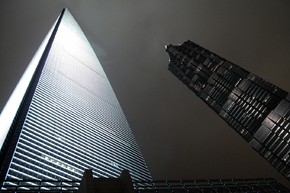
Skyscrapers loom above Shanghai. Urban gorwth in China is decreasing agricultural land. Photo by Curt Smith
The growth of Chinese cities is increasing wealth in the country, but it's coming at a cost, with farmers needing to make room for city dwellers as a consequence of the country's ongoing economic boom. The new study by Professor Xuemei Bai from the ANU Fenner School of Environment and Society has revealed that China is experiencing unprecedented and rapid urbanisation. "Between 1997 and 2006 more than 12,000 km² of land was converted into built-up urban areas," she said. "However, despite these rapid changes there is still debate about whether urban growth causes economic growth. "In this study we found that there is a strong and positive relationship between urban land expansion and economic growth in Chinese cities. There is also a feedback between the two, meaning that increased land expansion increases gross domestic product (GDP), which then leads to increased land expansion and so on. "On top of this, there are large spill-on effects, with urban land growth not only having a positive GDP impact for an urban area, but for the surrounding area as well." The study also showed that most of the land used for urban expansion in China came from agricultural land - causing more pressure in a country where per capita arable land is already well below the world average and where food security concerns are on the rise.
TO READ THIS ARTICLE, CREATE YOUR ACCOUNT
And extend your reading, free of charge and with no commitment.