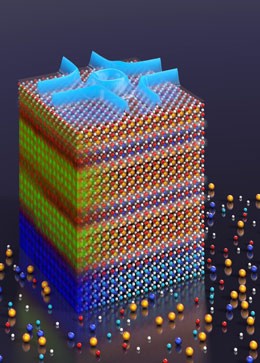
An artist’s rendering of a transition metal oxide superlattice, with an actual transmission electron microscopy image superimposed on the left panel. The red is manganese, yellow is lanthanum and blue is strontium. The top is a Fermi surface map which illustrates how electrons move in the material. <a href=" to enlarge
Materials called transition metal oxides have physicists intrigued by their potentially useful properties - from magnetoresistance (the reason a hard drive can write memory) to superconductivity. By combining two sophisticated experimental tools - oxide molecular beam expitaxy and angle-resolved photoemission spectroscopy - researchers have gained the first insights into quantum interactions in transition metal oxide superlattices, which are artificial stacked layers of alternating materials, each just a few atoms thick. Even slight modifications to the stacking sequence can switch the entire superlattice from a conductive to insulating state, due to the enhancement of quantum interactions between the electrons. The findings were published online Aug. Materials. "We are interested in superlattices of transition metal oxides because they can exhibit all sorts of exotic electronic and magnetic properties that do not exist in the bulk of these materials," said Kyle Shen, assistant professor of physics and paper's senior author. "They might be useful someday, but from a scientific standpoint, they are just really fascinating because the electrons can conspire to give rise to very unexpected emergent phenomena." For some transition metal oxide superlattices, it has been shown that adding just one extra layer of atoms to the stacked layers switches them from conductor to insulator.
TO READ THIS ARTICLE, CREATE YOUR ACCOUNT
And extend your reading, free of charge and with no commitment.