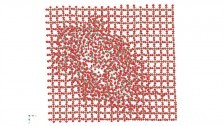
Nuclear damage Credit: Ian Farnan
How can we make nuclear waste safe for millennia? Fundamental research led by the University of Cambridge will help find the answers. Our aim is to predict the chemical alteration of the fuel for ages between 1,000 and 100,000 years, which spans the lifetime of the disposal canisters." - —Dr Ian Farnan The timescale for keeping hazardous nuclear waste isolated from living organisms is unimaginably long, with times specified by nuclear regulators in Europe and the USA ranging from 10,000 to 1,000,000 years. Who knows what the human race, or indeed the planet, will be like 40,000 human generations from now. Already, the world's nuclear power plants, which generate around a fifth of global electricity, have yielded in excess of 300,000 tons of high-level nuclear waste, a figure that will dramatically increase in the context of a world nuclear renaissance. Most of the waste is currently stored above ground in spent fuel pools or dry storage. But, as the Fukushima accident in 2011 showed, above-ground nuclear waste storage is vulnerable and there is broad agreement among nuclear-generating countries that the best option is to bury it deep and inaccessibly in the Earth. Understanding how to keep nuclear waste safe is clearly a considerable challenge, one that new research led by the University of Cambridge aims to help solve through fundamental studies of how nuclear materials behave, and are likely to behave, over massive timescales.
TO READ THIS ARTICLE, CREATE YOUR ACCOUNT
And extend your reading, free of charge and with no commitment.