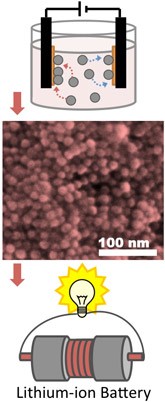
Nanoparticle battery electrodes deposited through electrophoretic deposition could lead to lighter and more efficient batteries. At top is a schematic of the EPD process. The middle is an electron microscope image of the nanoparticle electrode.
Materials scientists have developed a simple, robust way to fabricate carbon-free and polymer-free, lightweight colloidal films for lithium-ion battery electrodes, which could greatly improve battery performance. By developing a method for additive-free electrodes that maintain high conductivity, the researchers have opened new possibilities for reducing the weight and volume of batteries, while also creating a template system for studying the physics of nanoparticle electrodes. The work, led by Richard Robinson, assistant professor of materials science and engineering, and graduate student Don-Hyung Ha, is featured in the Oct. 10 issue of Nano Letters (Vol. No. Nanoparticles have been extensively investigated as an active cathode and anode in lithium-ion batteries - common components of electronic devices - because they can enhance the batteries' electrochemical properties. To use colloidal nanoparticles for the electrodes, it had been necessary to combine them with carbon-based conductive materials for enhancing charge transport, as well as polymeric binders to stick the particles together and to the electrode substrate, Robinson said.
TO READ THIS ARTICLE, CREATE YOUR ACCOUNT
And extend your reading, free of charge and with no commitment.