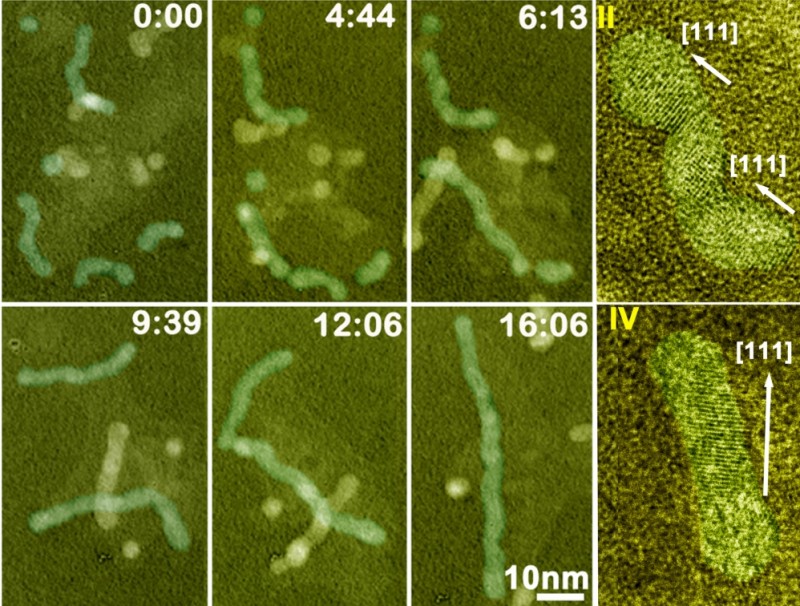
Sequential color TEM images showing the growth of Pt3Fe nanorods over time, displayed as minutes:seconds. Far right, twisty nanoparticle chains straighten and stretch into nanorods. (Images courtesy of Haimei Zheng)
This electron microscopy movie of nanocrystal growth shows nanoparticles becoming attached to form twisty chains that eventually align and attach end-to-end to become elongated nanowires. (Movie courtesy of Haimei Zheng) In the growth of crystals, do nanoparticles act as "artificial atoms” forming molecular-type building blocks that can assemble into complex structures? This is the contention of a major but controversial theory to explain nanocrystal growth. A study by researchers at the U.S. Department of Energy (DOE)'s Lawrence Berkeley National Laboratory (Berkeley Lab) may resolve the controversy and point the way to energy devices of the future. Led by Haimei Zheng, a staff scientist in Berkeley Lab's Materials Sciences Division, the researchers used a combination of transmission electron microscopy and advanced liquid cell handling techniques to carry out real-time observations of the growth of nanorods from nanoparticles of platinum and iron. Their observations support the theory of nanoparticles acting like artificial atoms during crystal growth. "We observed that as nanoparticles become attached they initially form winding polycrystalline chains," Zheng says. "These chains eventually align and attach end-to-end to form nanowires that straighten and stretch into single crystal nanorods with length-to-thickness ratios up to 40:1.
TO READ THIS ARTICLE, CREATE YOUR ACCOUNT
And extend your reading, free of charge and with no commitment.