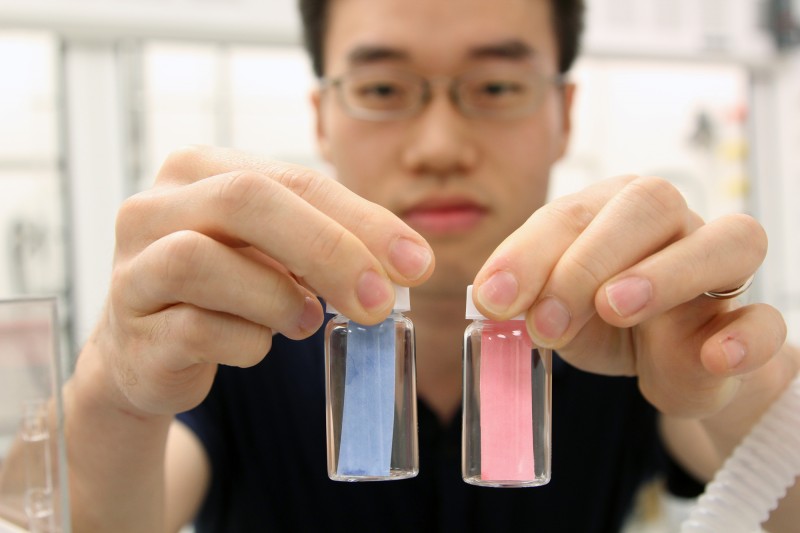
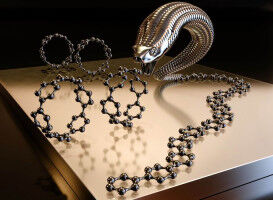
Sungbaek Seo, a doctoral student in the program in Macromolecular Science and Engineering holds paper litmus tests of Nerve Agent Detection at the NCRC building on UM North Campus. Image credit: Marcin Szczepanski/University of Michigan, COE Multimedia Producer
ANN ARBOR, Mich.-Nerve gases are colorless, odorless, tasteless and deadly. While today's soldiers carry masks and other protective gear, they don't have reliable ways of knowing when they need them in time. That could change, thanks to a new litmus-like paper sensor made at the University of Michigan. The paper strips are designed to change color from blue to pink within 30 second of exposure to trace amounts of nerve gas. "To detect these agents now, we rely on huge, expensive machines that are hard to carry and hard to operate," said Jinsang Kim, an associate professor in the departments of Materials Science and Engineering, Chemical Engineering and Biomedical Engineering in addition to the program in Macromolecular Science and Engineering. "We wanted to develop an equipment-free, motion-free, highly sensitive technology that uses just our bare eyes." A paper on their sensor is published online in Advanced Functional Materials. It will appear in a forthcoming print edition.
TO READ THIS ARTICLE, CREATE YOUR ACCOUNT
And extend your reading, free of charge and with no commitment.