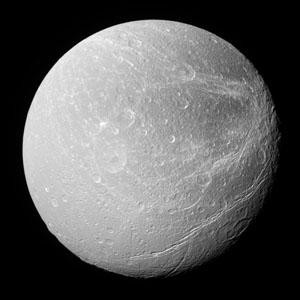
A southerly view of Dione shows enormous canyons extending from
mid-latitudes on the trailing hemisphere, at right, to the moon’s south
polar region. The image was taken in visible light with the Cassini spacecraft narrow-angle camera on Feb. 8, 2008.
Dione, one of Saturn's icy moons, has a weak exosphere which includes molecules of oxygen, according to new findings from the Cassini-Huygens mission. The international mission made the discovery using combined data from one of Cassini's instruments, called CAPS (Cassini Plasma Spectrometer), which includes a sensor designed and built at UCL's Mullard Space Science Laboratory. Dione joins Rhea and the main rings in Saturn's system in having an oxygen rich exosphere, as well as Jupiter's moons Ganymede, Europa and Callisto - the target for ESA's proposed JUICE (JUpiter ICy moons Explorer) mission for launch in 2022. Professor Andrew Coates (UCL Mullard Space Science Laboratory), one of the authors of the study said: "It now looks like oxygen production is a universal process wherever an icy moon is bathed in a strong trapped radiation and plasma environment. "Energetic particles hit the icy surface, the hydrogen is lost and molecular oxygen remains as an exosphere. We now know that this happens at Saturn's moons as well as Jupiter's - and it may well occur in extrasolar planetary systems too." - It now looks like oxygen production is a universal process wherever an icy moon is bathed in a strong trapped radiation and plasma environment. Professor Andrew Coates Cassini flew by Dione on 7 April 2010.
TO READ THIS ARTICLE, CREATE YOUR ACCOUNT
And extend your reading, free of charge and with no commitment.