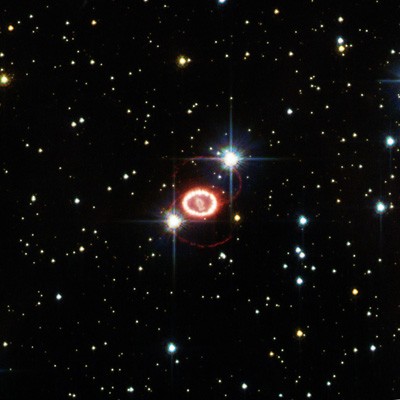
Supernova remnant SNR1987A is located 166 000 light-years away in the Large Magellanic Cloud. The light from the stellar explosion arrived at Earth in 1987, and has since provided astronomers with a natural laboratory to monitor how the brightness of a supernova changes over time. Dominating this Hubble Space Telescope view of the remnant are two glowing loops and a very bright ring of shocked hotspots surrounding the location of the now-exploded central star. The material making up these loops and rings was probably ejected from the star earlier in its history and is now being illuminated by the supernova and its shockwave. The titanium-44 detected by Integral is powering only the innermost part of the remnant. Astronomers expect a neutron star to have been left after the explosion, but no definitive evidence for it has yet been found. The field of view is about 25 x 25 arcseconds. Credits: ESA/Hubble & NASA
Radioactive decay of titanium powers supernova remnant The first direct detection of radioactive titanium associated with supernova remnant 1987A has been made by ESA's Integral space observatory. The radioactive decay has likely been powering the glowing remnant around the exploded star for the last 20 years. Stars are like nuclear furnaces, continuously fusing hydrogen into helium in their cores. When stars greater than eight times the mass of our Sun exhaust their hydrogen fuel, the star collapses. This may generate temperatures high enough to create much heavier elements by fusion, such as titanium, iron, cobalt and nickel. After the collapse, the star rebounds and a spectacular supernova explosion results, with these constituent elements flung into space. Supernovae can shine as brightly as entire galaxies for a very brief time thanks to the enormous amount of energy released in the explosion.
TO READ THIS ARTICLE, CREATE YOUR ACCOUNT
And extend your reading, free of charge and with no commitment.