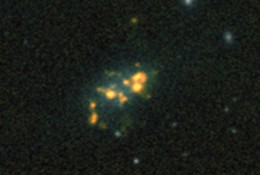
A dwarf galaxy, some 48 million light years away. The orange blobs are hydrogen gas clouds, the faint blue background around them, young hot stars. The white dots are distant background galaxies.
The mysteries of the evolution of the universe since the Big Bang are one step closer to being solved, thanks to research from The Australian National University. Astrophysics PhD candidate Mr David Nicholls from the Research School of Astronomy and Astrophysics, part of the ANU College of Physical and Mathematical Sciences, used the ANU 2.3 metre telescope at the Siding Spring Observatory to study distant dwarf galaxies. The galaxies are regarded as ideal 'laboratories' for finding out how the Universe has evolved since the Big Bang. "At the beginning of the Universe, the only elements around were hydrogen and helium. Big stars formed from these elements and, as they evolved, burned the hydrogen and helium into an 'ash' of heavier elements. This ash included nitrogen, carbon and oxygen, which are essential for life," Mr Nicholls said. "When these big stars ran out of fuel, they blew up in the form of supernovae and mixed the heavier elements back into the hydrogen clouds.
TO READ THIS ARTICLE, CREATE YOUR ACCOUNT
And extend your reading, free of charge and with no commitment.